Get Full Government Meeting Transcripts, Videos, & Alerts Forever!
Get email alerts on the Congressional Procedure topic
No spam. Unsubscribe anytime.
Scholar’s discovery prompts House to restore Jefferson’s 1812 additions to its Rules and Manual
Summary
Professor Brian Alexander presented archival research showing Thomas Jefferson annotated multiple copies of his 1801 Manual of Parliamentary Practice; the House Parliamentarian used that research this Congress to add language from Jefferson’s 1812 edition into the House Rules and Manual.
Professor Brian Alexander said his archival research into Thomas Jefferson’s annotated copies of the 1801 Manual of Parliamentary Practice prompted a change this year to the House Rules and Manual.
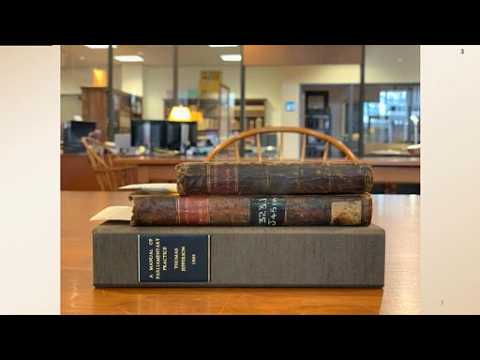
Alexander, a professor of American politics and international relations at Washington and Lee University, told an audience at a library lecture that he and students located multiple annotated 1801 copies and traced how Jefferson’s annotations accumulated into a set of additions that he intended for a later printing. "We can now say that Jefferson's final word on the manual lies not in the first edition of 1801... but with the publication of the second edition in 1812," Alexander said.
Why it matters: Jefferson’s Manual has long served as an authoritative reference for parliamentary procedure in the U.S. Congress. Alexander said the research clarified that several passages Jefferson added while serving as president — mainly on impeachment procedures, conference committees and a statement reaffirming the Manual’s purpose to protect both majority and minority rights — were omitted from House printings after an 1837 adoption that used the 1801 text. The House Parliamentarian reviewed Alexander’s findings and this Congress incorporated the 1812 language into the House Rules and Manual used by members.
Alexander described the research process and the evidence that led to the update. He said only three known 1801 copies bear Jefferson’s handwriting and that annotations in those copies are identical and cumulative: the longer Jefferson kept a copy, the more additions it contained. He and students catalogued surviving 1801 copies — about 100 were printed originally, and his team located roughly 72 extant copies — and searched institutional holdings for a short printed supplement Jefferson had produced around 1806, which researchers have not yet found.
Alexander urged archivists and rare-book librarians to check for printed leaves or supplements from circa 1806 that would corroborate Jefferson’s intended insertions. "When you're procrastinating, go to the library," he quipped during the lecture; he also quoted Jefferson’s remark that he "cannot live without books" when describing the scholar’s lifelong engagement with parliamentary law.
Alexander emphasized the practical effect of the House change is modest: the updated content does not rewrite contemporary procedure but restores language Jefferson intended and strengthens the precedent base relied on by parliamentarians. He described the change as a matter of respecting precedent: "By incorporating the updates from 1812... it's mainly a statement to respect precedent and the following of rules," Alexander said.
The event closed with audience questions about the 1837 adoption, why John Quincy Adams’s printing used the 1801 edition, and what specific rule passages were added; Alexander said the historical record provides no clear reason for the 1837 omission and that the 1812 additions are now reflected in the House manual. He also noted that a missing printed supplement (circa 1806) would be a valuable find for corroborating exactly what Jefferson distributed as additions during his lifetime.
The House Parliamentarian’s incorporation of Alexander’s research was described by the speaker as a collaborative, precedent-focused correction rather than a sweeping procedural overhaul. Copies of Alexander’s new edition of Jefferson’s Manual were available at the event, and he encouraged librarians and researchers to notify him and the rare-books staff if they locate the missing supplement.