Get Full Government Meeting Transcripts, Videos, & Alerts Forever!
Get email alerts on the Capital Improvement Program topic
No spam. Unsubscribe anytime.
Staff recommends Planning Commission find Oxnard’s 2027–2031 CIP "not a project" under CEQA
Summary
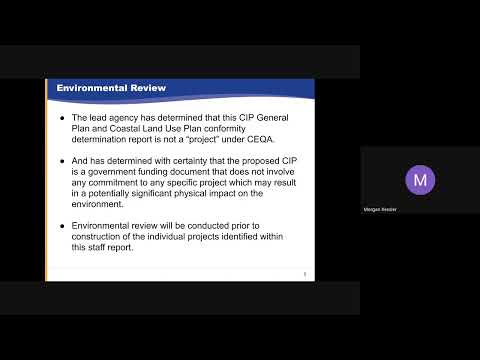
City Engineer Morgan Caswell told the April 16 Planning Commission that staff recommends the Commission find the proposed 2027–2031 Capital Improvement Program is "not a project" under the California Environmental Quality Act and adopt a resolution that 72 newly identified projects conform with the City of Oxnard 2030 General Plan and coastal policies; environmental review will occur at the individual project stage.
Morgan Caswell, the city engineer for the City of Oxnard, presented the proposed Capital Improvement Program (CIP) for fiscal years 2027–2031 at the April 16 Planning Commission meeting and recommended the commission find the CIP "is not a project as defined under the California Environmental Quality Act" and adopt a resolution that the newly proposed projects conform with the 2030 General Plan and coastal land use policies.
Caswell said staff frames the CIP as a government funding and planning document, not an individual construction project, and therefore "environmental review will be conducted prior to the construction of each individual project and the environmental process will be gone through at that time." That framing underpins staff's recommendation to treat this conformity determination as not subject to CEQA review at the program level.
Why it matters: the CIP guides which capital projects the city may fund and build over five years. Caswell said the 2027–2031 cycle includes 255 projects in total (177 existing projects, 72 newly identified projects, and six reclassified items) and has a total five-year value of "about 1.3 billion dollars." If the Planning Commission concurs, the advisory determination would move to the Planning, Public Works and Transportation Committee and then to the City Council for final action.
What’s in the new list: Caswell outlined examples among the 72 new projects including building repairs (parking-lot rehabilitation, fire station overhead door replacement, electrical- panel and HVAC work), parks and open-space land replacements, transportation and storm-drainage projects (bicycle and pedestrian improvements, asphalt repair and stormwater work), and enterprise utility projects for water, wastewater and environmental resources. The full list, Caswell said, is in the staff report provided to commissioners.
Legal references and staff recommendation: Caswell cited staff's CEQA rationale and referenced sections described in the presentation as "15601 B3 and 15378 B4," and asked commissioners to adopt Resolution 2026 XX finding the proposed additional CIP projects conform with the City of Oxnard 2030 General Plan and relevant coastal land use policies pursuant to Government Code section 65401.
Next steps: Caswell emphasized the Planning Commission's role is advisory; after the commission's review the CIP will be forwarded for committee input and then to City Council, with a target council date of May 19, 2026. He told commissioners that staff will be available at the meeting to answer questions.
No formal motion or vote is recorded in the presentation transcript; any formal actions would occur during the Planning Commission meeting and subsequent City Council consideration.