Get Full Government Meeting Transcripts, Videos, & Alerts Forever!
Get email alerts on the Data Center Project topic
No spam. Unsubscribe anytime.
Perry County planners raise environmental, water and infrastructure questions about proposed multi-building data center
Summary
At an April meeting, the Perry County Planning Commission reviewed a large, multi-building data center proposal and authorized review letters while flagging concerns about water supply, wastewater sizing, power substations and environmental impacts including possible local temperature increases and effects on cold-water streams.
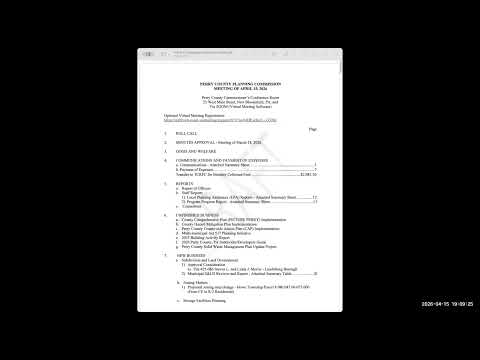
At its April meeting, the Perry County Planning Commission reviewed a proposed multi-building data center site plan and authorized staff to send review letters to affected municipalities, while members pressed for clearer technical information on water, wastewater, traffic and power infrastructure.
Jason, a staff planner, told commissioners that “the model TCRPC data center ordinance was posted” on the regional website and that municipalities would be notified, encouraging them to review the model if they wished to adopt or adapt it. The commission then turned to the submitted plan set, which reviewers said included ten buildings, large parking areas and two on-site substations.
Reviewers told the commission the plan set identified developed acreage of roughly 286.88 acres and showed two building footprints of about 155,727 square feet and 137,495 square feet. The submission included a water feasibility and wastewater assessment that a reviewer summarized as projecting about 30,000 gallons per day of domestic wastewater flow; the plan lists a sewage design capacity of 50,000 gallons per day. Commissioners said they needed clearer documentation of well testing and groundwater availability before any final approvals, warning that inadequate testing could risk off-site groundwater drawdown affecting nearby private wells.
Members also raised concerns about the plan’s traffic analysis: the submission compared its vehicle generation to a warehouse template and repeatedly deferred a final traffic impact statement for state review, saying PennDOT (PENDOT in the record) would make final determinations. Commissioners requested a site-specific traffic study and confirmation that applicable state reviews would be completed.
The commission discussed power infrastructure shown on the plan, including two roughly 150-by-450-foot fenced substation areas and incoming transmission lines. Commissioners asked whether the project was 'hyperscale' or the next tier down and whether two wells would be sufficient for the proposed development, noting that typical large data center complexes have substantially greater water demands.
Several members also raised environmental concerns. One participant emphasized recent research discussed in the meeting suggesting that large data center complexes can raise local land-surface temperatures and that added heat and transmission infrastructure could affect nearby high-quality cold-water streams and increase wildfire risk in wooded areas. The commission requested clearer environmental analysis, including hydrologic and thermal baseline data for nearby streams and an explanation of any planned closed-loop cooling or water recycling systems.
Reviewers flagged submission issues in the plan set — missing legend entries, placeholder graphics and some materials they described as early or 'placeholder' work. Commissioners said those gaps made it difficult to evaluate the project’s full impacts and advised that those details be completed before any final action.
The commission voted to send the standard letters of review on the municipal submissions, recording the procedural approval to forward comments and to have affected townships and review agencies continue technical review of water, wastewater and traffic studies.
Next steps noted by the commission included (1) requesting completed well test data and a site-specific water-availability report, (2) a clarified wastewater plan with operational details, (3) a focused traffic impact study and (4) more complete plan set graphics and legend entries so reviewers and the public can verify proposed infrastructure locations and dimensions.