Get Full Government Meeting Transcripts, Videos, & Alerts Forever!
Get email alerts on the Humanitarian Funding And Operations topic
No spam. Unsubscribe anytime.
Journalists press WFP on causes of rising hunger, data gaps and underfunding
Summary
In a Q&A after the Hunger Map Live demonstration, reporters asked why acute hunger surged, why some countries (e.g., Iran) lack recent national data, whether the map can track response coverage, and how WFP will handle an upcoming leadership transition; WFP officials stressed vetted numbers and funding constraints.
Journalists at the World Food Program briefing pressed WFP officials on the causes of the recent jump in acute hunger, gaps in country coverage and the agency’s capacity amid funding shortfalls and a leadership transition.
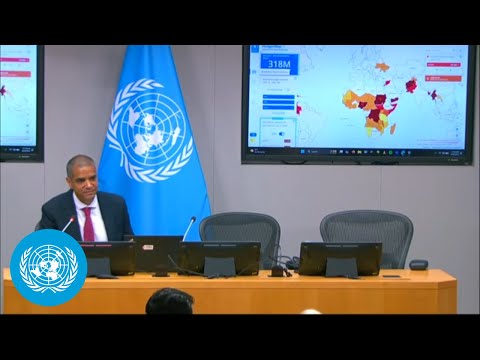
Edith Lederer (Associated Press) asked why the number of people suffering acute hunger rose so dramatically from pre‑COVID levels. Jean‑Martin (Director of Food Security and Nutrition Analysis, World Food Program) attributed the jump to pandemic disruptions to supply chains and livelihoods and a subsequent cost‑of‑living crisis driven by the conflict in Ukraine that pushed food and energy prices higher. “We had an increase of about…from 145 million in 2019 to almost 270 million just in 1 year,” he said, and added that conflicts in Sudan and Gaza have kept vulnerability levels high, contributing to a current total WFP presented as 318 million.
Jean‑Martin told reporters the most extreme category on the IPC five‑point scale (phase 5, catastrophe) rose from about 85,000 people in 2019 to 1.4 million last year, a fifteenfold increase attributed to access challenges, funding constraints and conflict. “That’s what’s going on and that’s why these numbers remain so high,” he said.
Several reporters raised data‑coverage questions. Namo Abdallah (Rudaw) noted Syria’s status on the map and asked why Iran appeared absent; Jean‑Martin said Syria is listed as a country of concern in hotspot layers and explained that Iran has not had a recent national food‑security assessment, which is why certain national statistics are not reported on the landing page.
Chris Ray (Canadian Broadcasting) asked whether the map could also show where humanitarian responses are being applied so users could spot coverage gaps. Jean‑Martin agreed a separate “solution map” could be useful and said WFP will consider adding response‑tracking layers; he also warned that many humanitarian operations are underfunded.
Reporters asked about WFP leadership after an announced departure in May. A WFP official present said the head of WFP is appointed jointly by the U.N. Secretary‑General and the Director‑General of the Food and Agriculture Organization and that the deputy will lead the organization while recruitment is ongoing, which the official said should ensure continuity.
Other questions connected organized violence to food systems: Evelyn Leopold asked whether cartels in Mexico had wider impacts on food systems; the presenter said WFP examines links between conflict/violence and food insecurity but that cartel‑related dynamics are not presented as a primary layer on the Hunger Map Live. Mona (Al Quds Al Arabi) asked whether attention to crises in the Middle East could crowd out resources for regions such as Borno State, Nigeria; WFP pointed to the map’s transparency, highlighted that Borno now contains populations in IPC phase 5 for the first time in a decade, and reiterated that limited funding leaves many operations underfunded.
The briefing closed with WFP urging journalists to explore the platform and use it to report on needs worldwide.