Get Full Government Meeting Transcripts, Videos, & Alerts Forever!
Get email alerts on the Land Use topic
No spam. Unsubscribe anytime.
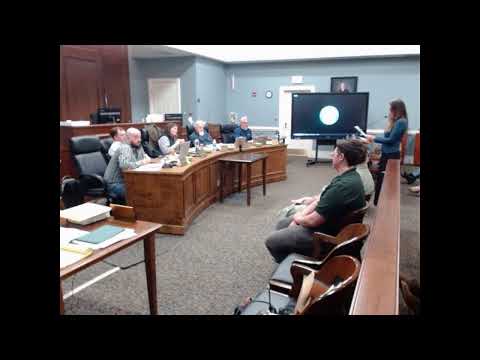
Nelson County residents press supervisors over Monroe Institute conference-center expansion
Summary
At a public hearing the Monroe Institute described a proposed conference center (capacity up to 90 guests, applicant cites $25 million investment and modest traffic) while neighbors and a planning commissioner raised objections about water supply, scale, traffic, and whether the project meets special-use criteria.
The Nelson County Board of Supervisors heard more than two hours of public comment on a special-use permit request from the Monroe Institute to build a conference center on agricultural-zoned land in the Newland area. The applicant said the facility would add residential quarters and meeting space to accommodate up to 90 guests and represent roughly a $25 million investment; the board did not vote and recessed for a break.
Justin Shimp of Shimp Engineering, representing the Monroe Institute, told the board the project would be limited to a single parcel and screened from most neighboring properties. He said the building footprint would be roughly in the 30,000–60,000 square-foot range discussed in materials, that the expansion would create about 10 additional jobs beyond Monroe’s current workforce, and that construction and operation would generate tax revenue (Shimp cited an estimated $140,000 in real-estate tax revenue and roughly $200,000 a year in lodging taxes at full capacity). Shimp said the Planning Department and the planning commission recommended approval (the planning commission voted 3–1 in favor) and described a traffic analysis that calculated about 58 added trips on peak days and an average daily impact comparable to “three or four single-family houses.” He also characterized the Institute’s water use as “non-consumptive,” described plans to install a screened fire-suppression tank (noted as 120,000 gallons) and said the applicant would pay for road widening and additional vegetative screening as permit conditions.
Dozens of neighbors who live near the proposed site addressed the board during the public hearing, many of them in opposition. Speakers who identified themselves as Newland subdivision residents said a 59,000-square-foot structure and a near-tripling of weekly workshop attendees (from about 30 to as many as 90) would alter neighborhood character, increase traffic on narrow rural roads, and harm viewsheds. Multiple residents raised water-supply concerns, urging more robust groundwater study and arguing the existing applicant analysis did not show the expansion would avoid negative impacts on private wells. One commenter (quoting a household estimate) calculated that 90 attendees could use roughly 6,300 gallons per day during workshops and said that over a year the total would be “millions of gallons,” a figure raised as a prompt for further hydrological review rather than as a board finding.
Richard Averick, who identified himself as a central-district planning commission member, told the board he could not reconcile the project with special-use criteria requiring that the use not change the character and established pattern of development and not adversely affect neighboring properties. Averick said that viewed as a 50,000–plus square-foot facility in a rural residential area, the proposal does not fit the comprehensive plan’s expectations for where large-scale development should occur.
Other residents expressed concerns about public safety and vetting (several cited anecdotal incidents and said the larger number of attendees raised questions about monitoring), the precedent a large approval might set for agricultural-zoned land, long-term outcomes if the facility were sold or closed, and the adequacy of enforcement mechanisms and online records for permit compliance. Supporters who spoke described Monroe as a long-standing steward of land and an employer that brings tourism dollars; several urged conditional approval with permit conditions and screening requirements.
Planning staff summarized conditions recommended to reduce visual and lighting impacts, limit one-day large events (weddings and festivals were noted as not permitted under conditions discussed), preserve tree lines, require directional glare-shielded lighting mounted no taller than 15 feet, and add a berm and evergreen plantings along the new parking area. The transcript shows the applicant and staff offering renderings and technical details and responding to board questions, but there was no final vote recorded in the provided transcript excerpt.
The board recessed for a 10-minute break and said it would return at 8:30 p.m.; the transcript ends before any final action. The record shows the Monroe Institute application was the subject of divided public comment, with the Planning Commission having recommended approval (3–1) but neighbors and at least one planning commissioner arguing the scale, water impacts, and consistency with the comprehensive plan require either denial or additional conditions or study.