Get Full Government Meeting Transcripts, Videos, & Alerts Forever!
Get email alerts on the State Grant Funding topic
No spam. Unsubscribe anytime.
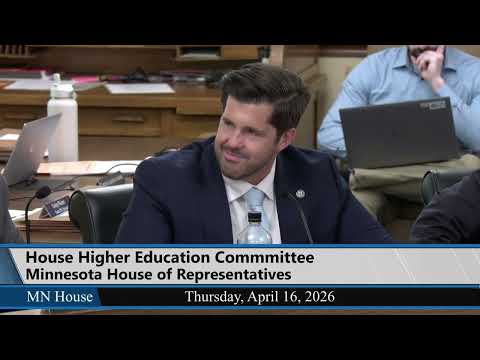
House higher‑ed committee advances HF4252 with contested changes to State Grant and tuition recognition
Summary
The House Higher Education Finance Policy Committee adopted DE2 to House File 4252 after policy and fiscal staff outlined technical corrections, a $1.5 million identity‑verification appropriation and an anti‑fraud provision. Members clashed over State Grant fixes and a tuition cap that would lower recognized tuition for University of Minnesota Twin Cities students, and multiple proposed funding amendments failed on 7–7 ties.
The House Higher Education Finance Policy Committee on May 12 adopted the DE2 amendment to House File 4252 and voted to refer the bill to the Ways and Means Committee after a day-long debate over changes to the State Grant program, a proposed tuition cap and spending for identity verification and anti‑fraud measures.
Nathan Hopkins of House Research told members the bulk of the DE2 consists of previously heard technical corrections and consolidations, and described several new items produced in negotiation: a requirement that public post‑secondary institutions explain the difference between developmental and credit‑bearing courses and obtain a signed acknowledgment from students; a new anti‑fraud provision; a one‑time $5,000 appropriation for reforestation at Bemidji State University; and an ongoing FY2027 appropriation of $1.5 million to fund an identity‑verification system to combat enrollment fraud, with contracts subject to the Government Data Practices Act.
"The majority of this bill contains technical corrections and consolidates reporting requirements," Hopkins said, and noted the tuition‑recognition language on page 41 would cap the recognized tuition for State Grant purposes at the lesser of an institution’s tuition or the average tuition charged across all public four‑year universities.
That tuition‑recognition change drew sustained concern from members and witnesses. William Luther, director of state affairs for the University of Minnesota Undergraduate Student Government, warned the cap would reduce State Grant awards for Twin Cities students and leave gaps for room and board, books and technology. "This will pull the financial aid package out from under students," Luther said, urging the committee to preserve cost‑of‑attendance treatment that accounts for living costs beyond tuition.
Nate Peterson, executive director of student finance at the University of Minnesota, told the committee the proposal would reduce recognized tuition for Twin Cities students and recommended either new funding or a broad, equitable rationing approach if further resources are not available. "In the absence of new funds, consider rationing that protects the lowest‑income students first," Peterson said, noting that retroactive changes to summer 2026 aid would create registration and balance problems.
Committee debate focused on how to close an estimated State Grant shortfall members described as roughly $131 million, created in part, members said, by 2023 changes that allowed the Student Aid Index to go as low as negative $1,500 for some students. Several Republican amendments proposed one‑time appropriations or policy changes to reduce program demand; Democrats argued one‑time or targeted changes would either be insufficient or harm low‑income students.
Representative Coulter’s Amendment 12, which would have provided a one‑time $60 million to the program, and Representative Allen’s Amendment 14, which would have tightened negative family contribution calculations and added $10 million, both failed on 7–7 roll calls. Representative Eric’s proposals to shrink Northstar Promise eligibility and redirect funds also failed, as did an amendment to add $30 million while restricting undocumented immigrants from state aid. Each contested amendment produced a tie vote.
Supporters of the negotiated DE2 said it represents the only compromise they could reach across the aisle on a package of technical fixes, an anti‑fraud provision and limited fiscal changes. "This is the only thing we landed on that we could agree to," Representative Eric said, urging colleagues to send the bill to Ways and Means where additional fixes could be considered.
Members and witnesses agreed further work is required to avoid disproportionate effects on students at particular institutions. Paul Cerkvenik, president of the Minnesota Private College Council, urged the Legislature to add new funds or adopt rationing applied uniformly across institutions rather than a tuition cap that would lower aid for students at higher‑tuition schools.
The committee adopted the DE2 (voice/confirmation) and referred HF4252, as amended, to the Ways and Means Committee for further deliberation and potential budget changes. The University of Minnesota and committee chairs indicated plans for additional informational sessions as the bill moves forward.
Next steps: HF4252 will be considered next in the House Ways and Means Committee; members said they hope to produce alternate funding options and policy refinements there.