Get Full Government Meeting Transcripts, Videos, & Alerts Forever!
Get email alerts on the Open Meetings topic
No spam. Unsubscribe anytime.
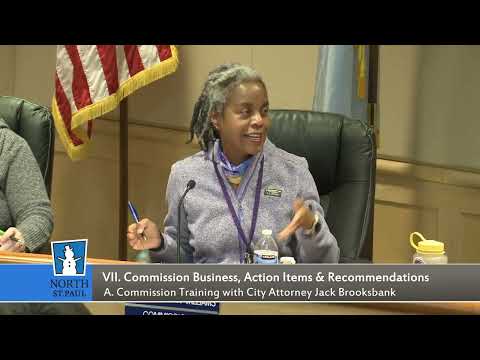
City attorney reviews open-meeting and data-practices rules with Arts & Culture Commission
Summary
City attorney Jack Brooksbank trained the commission on Minnesota open-meeting rules and the Government Data Practices Act, warning that quorums, serial communications and social-media threads can trigger public-meeting and public-record obligations and advising commissioners to use city email and staff posting to reduce discovery risks.
Jack Brooksbank, the city attorney, told the North St. Paul Arts and Culture Commission on Feb. 4, 2026, that "all meetings of public bodies must be open to the public," and laid out practical steps commissioners should take to avoid inadvertent violations of the state open‑meeting law and the Minnesota Government Data Practices Act.
Brooksbank said the law defines a meeting to include any time a quorum — more than half of the commission — discusses city business in person, by text, email, or on social media. He warned that serial communications (a chain of messages passing information among members) and comment threads on platforms such as Facebook that include four commissioners can be treated as public meetings.
The training emphasized the discoverability of government data. "If you are texting someone about commission business on your personal cell phone that is government data," Brooksbank said, noting that such communications could be subject to public records requests and, in an investigation, may require staff to collect device data. He advised commissioners to forward non‑city emails to their city account and to send event photos to city email so the files reside on city servers rather than on personal phones.
Commissioners asked several scenario questions — whether recurring events (art night, volunteer tents) require notice, how to handle attendance at community events, and whether Teams messages are discoverable. Brooksbank answered that recurring staffed activities should be noticed as meetings if the commission will be ‘‘working’’ there, but that simple attendance at a public event where no commission business is discussed is usually a social encounter and not a meeting. He confirmed Teams and city‑account messages are government data and searchable.
Brooksbank also covered conflicts of interest and gift restrictions, advising disclosure and recusal when a commissioner would receive a direct, special benefit (for example, an artwork installed on a commissioner’s property) and explaining that most fundraising by the city is not permitted: donations for city use must be accepted by city‑council resolution and commissions may recommend acceptance but cannot solicit money directly.
The training concluded with a reminder about recordkeeping for any formal action that spends public money and an offer to provide follow‑up materials through the commission’s liaison, Jordan.
Brooksbank encouraged caution and transparency and recommended that commissioners consult staff before engaging in communications that could raise open‑meeting or records issues. The commission did not take formal policy action during the training; follow‑up guidance will be provided to the commission via staff.