Get Full Government Meeting Transcripts, Videos, & Alerts Forever!
Get email alerts on the Education K12 topic
No spam. Unsubscribe anytime.
Vermillion high school adds 30-minute "Tanager Time," builds weekly staff collaboration; juniors post ACT composite of 19
Summary
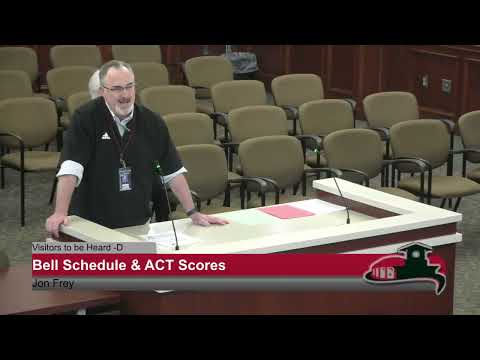
At the April 13 board meeting, high-school official Mr. Fry presented a revised bell schedule that inserts a 30-minute ‘Tanager Time’ and weekly 30-minute staff collaboration to support RTI/MTSS work; he also reported the junior class ACT composite averaged 19 with English 18.1, reading 20.1, science 19.7 and math 19.0.
At its April 13, 2026 meeting, Vermillion School District 13-1 high-school official Mr. Fry outlined a revised bell schedule that inserts a 30-minute period called "Tanager Time" into Monday–Wednesday and shortens other periods by about five minutes each to preserve total instructional minutes. He also said the plan creates a consistent 8:30–9:00 weekly collaboration block on Thursdays for instructional teams to meet about students who are struggling.
"To create that 30-minute Tanager Time, we essentially borrowed 5 minutes," Mr. Fry said, describing how seven shorter periods and slightly shortened block days produce space for individualized supports and teacher collaboration. He said Tanager Time will function as a quiet study hall in year one (2026–2027) and evolve in year two to support targeted pull-outs or small-group help.
Mr. Fry tied the schedule changes to the district's response-to-intervention (RTI) work and multi-tiered systems of support (MTSS). He said the advisory period for ninth- and tenth-graders will be used to build four-year personal learning plans, while junior-year advisory time will shift toward intensive ACT preparation led by designated teachers.
The presentation included statewide testing changes: Vermillion’s juniors took the ACT this year after the state moved away from the Smarter Balanced assessment for that grade. Mr. Fry reported, "We were able to test 100% of the students in the junior class and Vermilion High School received a composite average score on the ACT of 19." He provided a breakdown of subscores: English 18.1, reading 20.1, science 19.7 and math 19.0.
Mr. Fry said the one-shot ACT administration helps explain earlier discrepancies in math performance under the prior Smarter Balanced test, asserting, "I'm here to tell you tonight it was the test," and adding that the math teachers had been "vindicated" by the more comparable results. Board members praised staff for the work and said they will monitor how Tanager Time and advisory affect attendance, student preparedness and relationships with teachers.
Administrators emphasized that the first year will prioritize logistics and expectations before moving to targeted interventions, and said software tools may be needed to route students efficiently to targeted teachers during Tanager Time. The district plans to keep block days on Thursday and Friday and to provide a senior capstone worth half a credit beginning next year.
The board did not take final action on the schedule at the meeting; administrators said implementation details and further staff engagement will continue through the spring and into the 2026–27 school year.