Get Full Government Meeting Transcripts, Videos, & Alerts Forever!
Get email alerts on the Housing Policy topic
No spam. Unsubscribe anytime.
Committee hears 'Housing Opportunities' rezoning and code package to speed housing production
Summary
Committee members and staff reviewed CB 121196, a seven-part Housing Opportunities Package proposing targeted rezonings (U District, Fremont/Stone Way, Rainier Beach, Belltown and YMCA/community sites), incentives for grocery-linked redevelopment in Lake City, and code changes to remove barriers to modular, passive-house and mass-timber construction.
The Seattle Land-Use and Sustainability Committee on April 15 received an initial briefing on Council Bill 121196, the Housing Opportunities Package (HOP), a multi-component rezoning and code package designed to accelerate housing production on identified opportunity sites.
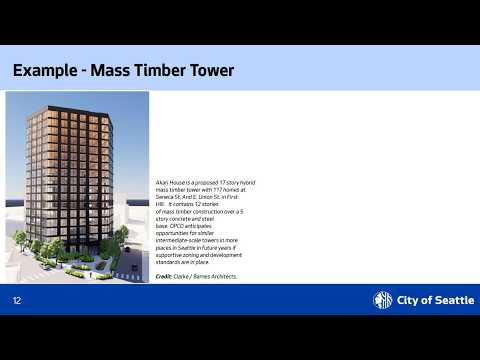
OPCD land-use staff described the bill’s seven components: targeted rezonings in the Fremont/Stone Way area, the downtown retail core, Rainier Beach (near light rail), the University District YMCA site and East Madison YMCA site; temporary height increases in Belltown to encourage infill housing; and code changes to enable passive-house, modular and mass-timber construction and conversions from commercial to residential uses. An incentive tied to the former Fred Meyer–sized site in Lake City would allow extra height if a large grocery and at least 200 housing units were included.
The presenter summarized the rationale: remove regulatory barriers and unlock sites that owners and community partners have identified as poised for redevelopment. "The purpose of this legislation is to make some focused changes to the city’s land use code and zoning that can support additional housing supply," the land-use policy manager said.
Public commenters and industry representatives largely supported the package. Developers and construction‑sector witnesses said the changes would help incorporate mass-timber and modular construction techniques, shorten construction timelines and create workforce pathways into apprenticeships. Mike Brown of the North Coast States Carpenters Union said the bill would create "real, long-term careers" through timber-construction training; industry representatives said the measures would reduce barriers to modern building methods.
Councilmembers probed definitions and guardrails. Members asked how sites were selected; OPCD staff said proposals came from owners, community partners and public outreach and that SEPA determinations and prior engagement informed the choices. On modular construction and passive‑house incentives, staff said they relied on state definitions and programs (for modular certification) but are open to clarifying amendments to ensure incentives apply only where intended.
The committee again did not take final action. Staff and OPCD will continue to refine definitions (for example, tying modular incentives to state modular certification and clarifying passive-house certification tiers) and brief the committee on requested clarifications.
What’s next: amendments and finer policy drafting ahead of additional committee review and public hearings on the rezoning and code changes.