Get Full Government Meeting Transcripts, Videos, & Alerts Forever!
Get email alerts on the Environmental Policy topic
No spam. Unsubscribe anytime.
Council advances first reading of ordinance to regulate hazardous‑waste storage; sends measure to committee after public comment
Summary
Laurens County Council approved first reading of Ordinance 1010 on April 13 to create an application-and-review process for hazardous and non-hazardous waste-storage facilities, voted 6‑0 on first reading and referred the ordinance to the Health & Emergency Services committee after public comment urging stronger local authority.
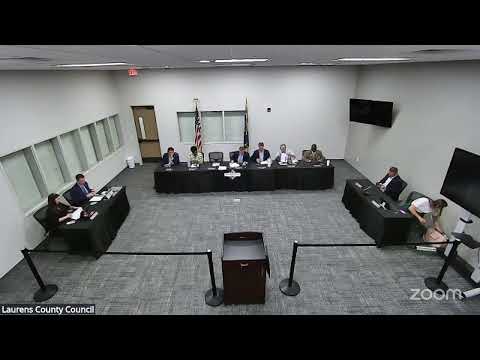
Laurens County Council gave first reading approval to Ordinance 1010 on April 13, a proposed ordinance to regulate hazardous and non‑hazardous waste‑storage facilities and to establish an application and county review process. The council approved the first reading 6‑0 and referred the ordinance to the Health & Emergency Services committee for additional testimony and legal review.
Local consultant Rick Shealy urged the council during public comment to adopt the ordinance, arguing that because Laurens County lacks zoning the county should have an ordinance to "regulate the location, the size, and the type of waste facility coming into the county" while explicitly exempting agricultural activities. Shealy told the council the draft would give council authority to regulate such facilities in the absence of zoning.
County staff and the county attorney clarified that state law governs hazardous‑waste facilities and that any local ordinance would supplement, not supplant, South Carolina requirements. During discussion the county attorney noted South Carolina hazardous‑waste statutes and the limits of local authority; council members asked committee members and staff to research potential conflicts with existing county codes (for example enforcement and penalty provisions) before the committee meeting.
Why it matters: proponents said the ordinance would provide local oversight and a formal review path for proposed waste facilities in a county without zoning. Opponents or concerns raised in the meeting centered on statutory preemption and how the local penalty structure would interact with existing ordinances.
What council did: the body approved first reading 6‑0 and assigned Ordinance 1010 to the Health & Emergency Services committee for further testimony and legal analysis; staff invited the petitioner (Rick Shealy) to testify before the committee.
Next steps: The Health & Emergency Services committee will schedule additional hearings and legal review; county staff said committee members will examine potential conflicts with existing enforcement and fine provisions and return recommendations to full council.