Get Full Government Meeting Transcripts, Videos, & Alerts Forever!
Get email alerts on the Economic Development topic
No spam. Unsubscribe anytime.
EDC says $219 million in 2025 investment, flags proposed $1 billion peaker plant and energy-timing issues
Summary
Greg Hildebrand, Marshall County Economic Development Corporation president, told the county council the county saw about $219 million in capital investment last year and described a proposed $1 billion peaker-plant project with long lead times and uncertain local tax revenue depending on abatements; he also discussed how different types of data centers affect grid demand and workforce implications.
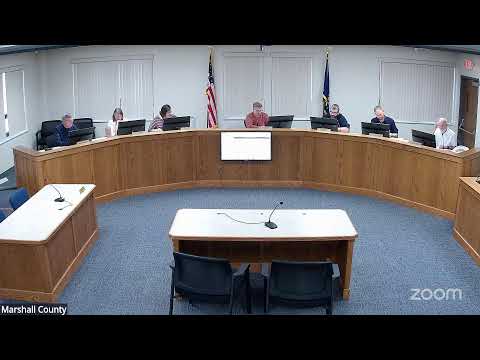
Greg Hildebrand, president and CEO of the Marshall County Economic Development Corporation, told the Marshall County Council on April evening that the county had a “banner year” in 2025, with about $219 million in capital expenditures.
Hildebrand said the EDC is tracking several large projects and one potential energy project in North Township that, in the developer’s preliminary material, would represent about $1 billion in equipment and real‑estate investment. He said the pro forma included roughly 200 construction jobs over 18–24 months and about 10 full‑time operational positions, and estimated a county tax yield of about $30 million over 10 years if the project were taxed at full assessed value. He cautioned, however, that any abatements or incentive packages would change the local fiscal outcome and later clarified his $30 million figure applies to a 10‑year span.
Why it matters: a project of that scale could affect county revenues, workforce needs and permitting, but Hildebrand emphasized multiple uncertainties. He said developers must clear regional queue processes (PJM), meet safety and permitting requirements, and account for long equipment lead times. “That process alone takes one to two years,” he said of grid-queue entry, and he added that turbine lead times are currently five to seven years, meaning any new generation would be years from commercial operation.
Hildebrand also addressed questions about data centers and their effect on the grid, distinguishing between hyperscaler facilities used for AI workloads and smaller mission‑critical centers. He explained some operators (including certain cryptocurrency miners) can be paid to curtail demand during peaks or to run during low‑cost hours, which can help level grid demand. “Not every data center is a hyperscaler,” he said, adding that some smaller operations can be beneficial because they can help smooth demand cycles.
On workforce and incentives, Hildebrand noted statewide changes in grant programs and incentive calculations. He reported that a state manufacturing readiness grant was discontinued and said the EDC is lobbying to restore similar support. He also warned that the Indiana Economic Development Corporation’s (IEDC) method of pegging incentive eligibility to average county wages can disadvantage counties whose averages are skewed by high‑paying headquarters employers; he suggested occupation‑level wage measures would better match incentive targets to local hiring needs.
Hildebrand highlighted local entrepreneurship and tourism wins — two Marshall County small businesses were singled out in a state entrepreneurship publication — and detailed outreach and training programs intended to help expand the local skilled workforce.
What’s next: Hildebrand’s briefing provided a preliminary fiscal view for the council; no formal approvals or abatements were requested during the presentation. Council members asked follow‑up questions about potential abatements, timeline and local impacts; staff and elected officials will consider those factors if a formal proposal or incentive package is put forward.