Get Full Government Meeting Transcripts, Videos, & Alerts Forever!
Get email alerts on the Quantum Networking topic
No spam. Unsubscribe anytime.
Dr. Mario Kiran details quantum networking work at Oak Ridge National Laboratory
Summary
Dr. Mario Kiran, group lead for quantum networking and communications at Oak Ridge National Laboratory, described lab experiments that generate entangled qubits for transmission across campus and said AI is needed to manage fragile quantum links for sensors and computers.
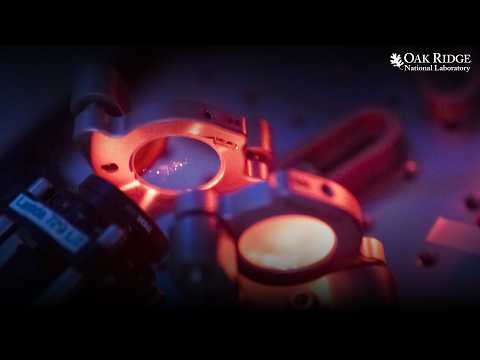
Dr. Mario Kiran, group lead for quantum networking and communications at Oak Ridge National Laboratory, demonstrated tabletop experiments that generate entangled qubits and send them between buildings on the ORNL campus to test quantum networking concepts.
At the lab demonstration, Kiran said researchers "generate cubits from sources by shining light onto them, entangling them and then sending them across to different buildings across ORNL to do real experiments in the quantum networking." She emphasized these are practical experiments intended to move beyond isolated lab results to campus- and field-scale tests.
Why it matters: quantum networks connect quantum devices — such as sensors and quantum computers — using quantum bits rather than classical bits, which could enable new sensing and computing capabilities. Kiran said Oak Ridge’s mission of "big science at scale," its facilities and national-infrastructure role, and alignment with Department of Energy priorities such as nuclear energy and grid resilience make the laboratory well placed to develop and test these networks.
Kiran explained technical differences between classical and quantum networks: "you could think of [a quantum network] is a network that actually connects quantum devices ... It's very different from [the] current internet ... where you're only sending data in bits. Now we're sending data in cubits." She said quantum resources are limited and sensitive to loss and latency in fiber links, which constrains deployments.
On the role of artificial intelligence, Kiran said AI will be essential to operate quantum networks in real time. "You will need AI to do intelligent control of the quantum network itself because quantum network ... the resources are limited. It's very fragile ... So AI plays a key role in quantum networks to actually drive the physics we have on tabletop experiments to actually system engineering out in the field into real world deployments." She described AI’s role as optimizing scarce quantum resources and providing adaptive control to stabilize the network.
The demonstration focused on laboratory methods for creating entanglement, the campus-scale transmission of quantum signals, and control challenges that must be solved before such networks can be deployed beyond testbeds. Kiran framed the work as part of ongoing efforts at ORNL to apply quantum technologies to mission areas including energy and grid resilience.
The on-camera session ended after Kiran’s explanation of AI’s role; no formal actions or policy decisions were recorded during the demonstration.