Get Full Government Meeting Transcripts, Videos, & Alerts Forever!
Get email alerts on the Wildfire Preparedness topic
No spam. Unsubscribe anytime.
Corrales officials outline wildfire-preparedness steps; urge residents to sign up for Code Red
Summary
At a Corrales Village wildfire-preparedness workshop, Deputy Fire Chief Tanya Laton and other officials urged residents to sign up for the Code Red emergency-notification system, harden homes (defensible-space zones), prepare animal evacuation plans and keep narrow private roads and utility easements clear to aid emergency response.
Deputy Fire Chief and emergency manager Tanya Laton opened Corrales Village’s wildfire-preparedness workshop by urging residents to sign up for Code Red, the village’s emergency notification system, and to keep their contact and address details up to date so responders can find them quickly. “Code Red is our emergency communication system,” Laton said, adding that notifications can be targeted to neighborhoods or sent village-wide depending on the incident.
Why it matters: Officials said precise location information and rapid notification save lives and speed response during ember-driven wildfires and other fast-moving hazards. Laton and Fire Chief Martinez described a set of homeowner actions — from clearing a 0–5 foot perimeter to spacing trees and securing woodpiles farther out — designed to reduce the chance that embers or radiant heat will ignite homes.
Officials advised residents to call 911 (not the fire station) to report smoke or active fires so dispatch can coordinate units and keep callers on the line for critical details. They recommended making road signs visible, using tools such as What3Words or river/levee mile markers to give precise locations, and keeping family evacuation plans and “go bags” ready with at least 72 hours of supplies.
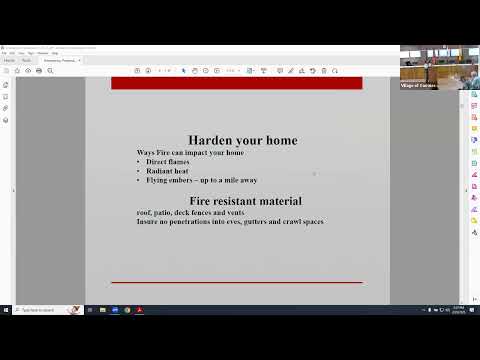
On home hardening, Laton described three defensible-space zones: Zone 0 (0–5 ft) should feature gravel, pavers or concrete and should not have flammable plants or wood fences attached to the house; Zone 1 (5–30 ft) requires removal of dead vegetation and trimming near windows; Zone 2 (30–100 ft) should limit combustible materials and maintain healthy, spaced vegetation. “Embers have been known to travel up to a mile away,” Laton said, urging use of fire-resistant roofing, enclosed vents and noncombustible fencing where feasible.
Animal and evacuation planning: Officials spent substantial time on large-animal evacuation. They urged owners to mark animals, keep vaccination and ownership papers accessible, and plan for water needs (official guidance cited roughly 20–30 gallons per horse per day). The village’s animal-control and emergency teams can open animal evacuation sites, but officials emphasized owners should prepare to move animals quickly and coordinate with friends or neighbors who can shelter them.
Infrastructure and access concerns: Chief Martinez and Laton flagged two recurring operational problems: (1) many private roads are narrower than recommended for fire apparatus and may have low tree branches that block access; (2) vegetation in utility easements is a frequent cause of line contact fires. Officials said the utility (referred to in the meeting as “P&M”) is responsible for easement clearing but homeowners must grant access; in some cases, resolving denials may require legal steps. The department also noted ongoing hydrant and water-line improvements on Andrews to improve water availability near the bosque.
Community cooperation and resources: Presenters urged residents not to block emergency gates or cul-de-sacs, to practice alternate evacuation routes, and to maintain family and out-of-town contact lists so loved ones can be checked off during a major incident. Resources cited included the village website (for Code Red signup), ReadyForWildfire.org, What3Words, IBHS demonstrations and Western Fire Chiefs Association plant lists. Laton noted a bill pending in Santa Fe that, if adopted, could offer a tax credit to help homeowners purchase emergency generators.
The meeting closed with an invitation for property visits by fire staff, announcements of volunteer wood-removal dates, and a plan to post the presentation materials on the village website and YouTube channel. Officials encouraged residents with questions to contact the fire department directly.