Get Full Government Meeting Transcripts, Videos, & Alerts Forever!
Get email alerts on the Financial Institutions topic
No spam. Unsubscribe anytime.
Coral Gables planning board defers controversial 'active street' rules for banks after public pushback
Summary
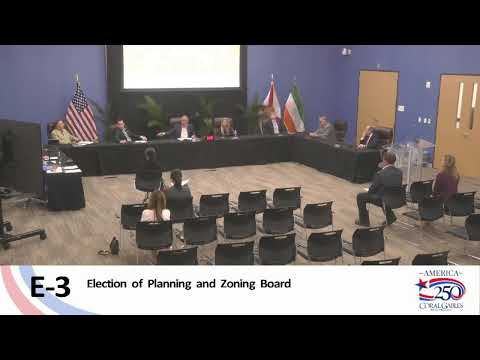
After extended debate and public comment on April 15, the board unanimously deferred a zoning text amendment that would define financial institutions and require 'active street-front' uses (for example, a cafe or retail component) for banks on certain corner sites in overlay districts.
The Coral Gables Planning & Zoning Board on April 15 voted to defer consideration of a proposed zoning text amendment that would create a separate definition for financial institutions and require new corner bank branches in certain overlay districts to include an "active street-front use" intended to sustain pedestrian activity.
Planning staff described the amendment as targeted to high-visibility locations — new development, changes of use, or substantial facade modifications in overlay districts such as the central business district and designated mixed-use corridors. Craig Southern said the city’s inventory identified 74 financial-service locations citywide (51 banks and 23 other financial services), with 46 in overlay districts, 31 on ground floors and nine occupying prominent corner frontages. "These are the locations that have the greatest influence on pedestrian experience," Southern said.
Under the proposal, corner bank branches would be required to incorporate a publicly accessible active use — examples in the draft included restaurants, cafes, retail, galleries or fitness studios — either by dedicating a percentage of floor area (proposed example: 25 percent) or by providing a minimum customer-service depth (an example listed was 20 feet across half the linear frontage). Staff also proposed incentives such as parking reductions and extra signage for projects that met activation standards.
The draft drew sustained questioning from board members over scope and unintended consequences. Several members noted that the city's Miracle Mile corridor — frequently cited in staff examples and news coverage — has high frontage depths and rents that may make such carve-outs impractical. Board member Nester Mendez and others asked whether the rules would apply citywide or be limited to specific blocks. Staff said the draft is targeted to listed overlay districts and is triggered only for new development or substantial alterations, and that existing banks would be grandfathered.
Mario Garcia Sera, speaking for PNC Bank, said a vacant building his client seeks to occupy has been empty for five to 10 years and that a requirement that 25 percent of a roughly 3,000-square-foot branch be non-banking space "would kill that proposal." He urged the board to consider incentives rather than obligations and warned of unintended consequences for parts of the city outside Miracle Mile.
Board members also raised operational and security concerns — including proximity to a high school and the practicality of sharing back-of-house facilities — and whether similar obligations apply to other non-retail uses. Several members suggested narrowing the scope (for example, piloting measures on Miracle Mile) or making activation measures voluntary and incentive-based.
After deliberation and public comment, the board voted unanimously to defer the item to a date uncertain and asked staff to return with a revised, narrower proposal or pilot approach that addresses feasibility, site economics and security concerns.