Get Full Government Meeting Transcripts, Videos, & Alerts Forever!
Get email alerts on the Municipal Budget Nonprofit Funding topic
No spam. Unsubscribe anytime.
Charlottesville council reviews FY27 nonprofit funding as staff corrects HOPS spreadsheet error and nonprofits press for restorations
Summary
City staff outlined FY27 recommendations for the Vibrant Community Fund and HOPS housing grants, noting application volumes, tiered award percentages and a spreadsheet error that undercounted one HOPS request; more than 60 nonprofit speakers during public comment urged council to restore or increase funding for programs across health, youth, arts and housing.
City staff briefed the Charlottesville City Council at a work session on the proposed FY27 budget for outside and nonprofit agencies, describing a high volume of requests and a tight funding envelope while nonprofits used public comment to urge restored or increased support.
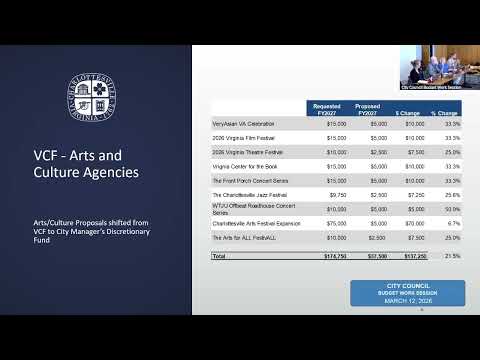
The city manager and budget staff said the Vibrant Community Fund (VCF) received 86 applications in the FY27 cycle (plus nine arts-and-cultural-event applications handled separately). They reported total VCF requests — excluding one application that was moved to housing funding — exceeded $5.4 million compared with roughly $2.6 million proposed in the budget, driving tiered award levels. Staff said the review panels included about 35 community reviewers and that orientation materials and scoring matrices are posted on the city’s website.
Acting housing program manager Maline Metsler explained that HOPS (Housing Operations and Program Support) received 14 applications requesting just under $1.4 million while $575,000 is available. Applications were scored on a 105‑point rubric and grouped into funding tiers; staff described initial award‑level percentages for tiers and the methodology for allocating funds proportionally to request amounts.
Metsler told the council that an internal spreadsheet formula error pulled an incorrect request amount for one applicant. The error had reduced Patchchum’s recorded request from $120,000 to $30,000, which would have produced an erroneously small recommended award. Once identified, staff consulted the HOPS committee and corrected the figures, keeping total HOPS allocations at $575,000 but adjusting the distribution among tiers. Metsler said the corrected HOPS report was published following the discovery.
Staff also flagged a set of eligibility issues: six VCF applications were deemed ineligible after review — most commonly because the applicants did not hold 501(c)(3) status or had preexisting city agreements. Presenters acknowledged that outreach to those affected organizations could have been handled better and promised procedural improvements.
Several other procedural clarifications were given: arts-and-cultural event requests are reviewed in a separate lane and some event support is being funded from a city 'quality of life' discretionary pool (initially allocated at $500,000 in year one and being built over multiple years); grantees will sign agreements within three months of budget approval, must use funds within 12 months, and must submit quarterly reports as a condition of payments.
Public comment stretched across dozens of speakers from small and long-standing nonprofits. Representatives from Loaves & Fishes, Big Brothers Big Sisters, Boys & Girls Clubs, Live Arts, New City Arts, the YMCA, hospice providers, maternal- and child-focused groups, health services, reentry programs, and many neighborhood-based programs described services and outcomes and urged council to maintain or restore prior funding levels. Several organizations asked council to consider reallocating discretionary funds or to top off the VCF/HOPS pools so more programs could be funded at previous levels.
Bennett’s Village speakers said their inclusive playspace project at Penn Park was deemed ineligible under the VCF rules because of an existing city memorandum of understanding; they asked staff and council to identify alternative city funding pathways to support phase two. Other nonprofits highlighted formulaic reductions tied to the proportional-percentage allocation method and asked the council to consider one-time supplements or strategic fund transfers to mitigate steep cuts.
Council members acknowledged the volume and intensity of requests, discussed a possible discretionary supplementation in the ballpark of $100,000–$150,000 from strategic funds, and asked staff to follow up with corrected spreadsheets and additional detail where slide numbers looked inconsistent. The city attorney reminded members that only the full council may make funding decisions to avoid private commitments by individual councilors.
Next steps: staff noted two upcoming opportunities for public input — a Monday meeting that will accept comments on the tax rate and a required April 6 public hearing on the tax rate — and the council’s planned adoption target of April 9. Councilmembers said they would continue to digest public comments and emailed materials and may bring forward supplemental funding options during the remaining work sessions.
The work session closed without final votes on any grants; any funding changes or supplements would require a future council action.