Get Full Government Meeting Transcripts, Videos, & Alerts Forever!
Get email alerts on the Education Budget topic
No spam. Unsubscribe anytime.
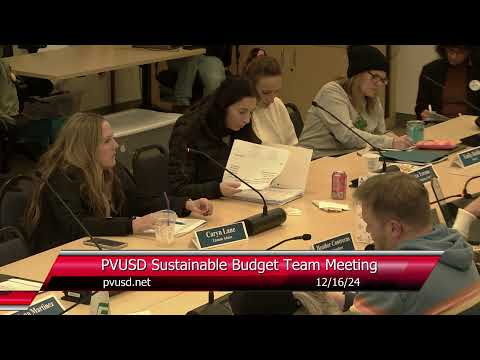
Sustainable budget team narrows recommended cuts, debates PVPSA contract versus district counselors
Summary
Pajaro Valley Unified’s Sustainable Budget Team refined draft recommendations to present to the Board of Education, debating whether to cut more from the PVPSA mental‑health contract or from district-employed social‑emotional counselors; members agreed to revise slides and present multiple options at the Jan. 15 board meeting.
The Sustainable Budget Team for Pajaro Valley Unified reviewed a draft presentation and wrestled on Wednesday with competing ways to reach a district reduction target now estimated at roughly $5 million to $5.6 million as one-time COVID (ESSER) funds expire and enrollment declines.
The committee’s draft slide deck lays out five configuration options and previously convergent recommendations (options B and D) that together totaled about $5.6 million in reductions. Staff said a $5 million reduction would be a conservative immediate goal but recommended a phased approach to avoid “draconian” cuts next year. "This is a recommendation to the board — ultimately it’s the board’s decision," the meeting chair told the group.
Why it matters: the district absorbed many pandemic-funded positions into ongoing budgets while enrollment fell, and those one-time funds are ending. The team was charged with producing a recommendation that balances fiscal solvency with maintaining instructional programs and equitable student supports.
Discussion centered on two fault lines. One was how much to reduce the district’s contract with PVPSA (a community partner providing clinical mental‑health services) versus preserving district‑employed general‑education mental‑health clinicians and social‑emotional counselors on campus. Staff said that PVPSA’s contract grew during the pandemic and that the district currently contributes close to $2 million toward that partnership; they also confirmed a $500,000 contract reduction that has already been negotiated. "We can reduce it by $500,000 and we have that paperwork here," a staff member said.
Members urging deeper PVPSA cuts argued the district could redirect funds to employ counselors who would be on site full time. One parent and committee participant said cutting PVPSA could free up substantial funds and argued that on‑site staff better meet students’ everyday needs. Counterpoints from staff and other members noted that partner agencies provide clinical licensing and supervision that the district does not currently have the capacity to replicate quickly; staff cautioned that billing to insurance or moving clinicians to a new employer would likely take a year or two and would not fully cover current costs.
The meeting also featured detailed questions about funding sources. Staff explained that some supports are paid from restricted grant accounts (including some pandemic‑era learning recovery grants and contracts) while the district’s structural deficit is primarily in the unrestricted general fund. The chair and finance staff clarified that Measure M (state facility bond) money is legally restricted to capital projects and cannot be used to backfill general operations.
Faced with unresolved technical and ethical concerns about cutting positions that directly touch students, the committee split into small groups and returned with alternative configurations: several groups recommended keeping the total closer to $5 million and redistributing portions of the $650,000 difference back into general‑education mental‑health clinician lines and social‑emotional counselor funding; other groups proposed deeper reductions to PVPSA with a corresponding increase for on‑site staff.
Outcome and next steps: the team asked staff to rework the slide deck to show the original consensus option (about $5.6 million) plus two revised options developed at the meeting, circulate the updated slides, and collect presenters’ talking points by the end of the week. The committee remains a recommending body; the Board of Education will review the materials and is scheduled to receive presentations on Jan. 15, 2025. The team also scheduled follow‑up small‑group work and assigned presenters to slide ranges for the January presentation.
What remains unresolved: the precise mix of reductions (district office versus student‑facing positions, and how much more to cut from PVPSA) and the feasibility of rapidly shifting clinical supervision and billing arrangements to other providers. Staff said those operational changes would likely take a year or more to implement and will not immediately erase the budget gap.
Reporting note: quotations and attributions in this article are drawn from the Sustainable Budget Team meeting transcript; where remarks could not be confidently matched to a named speaker in the record they are presented as statements reported from the committee discussion.