Get Full Government Meeting Transcripts, Videos, & Alerts Forever!
Get email alerts on the Urban Forestry topic
No spam. Unsubscribe anytime.
Carbondale tree board approves Chacos Park planting plan after debate over mature elm and species mix
Summary
The Carbondale Tree Board approved the design-development planting plan for Chacos Park after hearing a lengthy presentation from town staff and designers and debating species choices and the fate of a mature Siberian elm on the site. The plan emphasizes a stacked canopy, structural soils and pedestrian-first connections to Fourth Street Plaza.
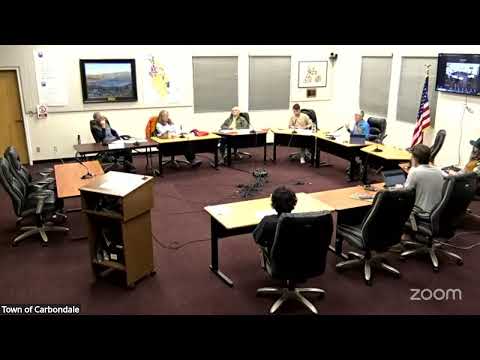
The Carbondale Tree Board on April [date not specified] voted to approve the design-development planting plan for Chacos Park after a multi-hour presentation by Parks & Recreation staff and the project's landscape design team and an extended board discussion over species mix and a mature Siberian elm on the site.
Parks & Rec Director Eric Braninger and landscape architect Nicholas D. Frank presented the plan and said the concept converts Chacos Park into a year-round, pedestrian-first town square connected to the adjacent Fourth Street Plaza. "This is a really fun project. We're really excited about it," Braninger said as he introduced the design goals: a stacked canopy and understory planting scheme to frame the park, improve accessibility by removing curbs and creating a continuous surface to the plaza, and use drought-tolerant, Roaring Fork Valley'adapted species.
The planting plan calls for larger canopy trees (including honeylocust and Kentucky coffee tree), a line of service-berry trees to visually and physically connect the park to Fourth Street Plaza, and ornamental understory plantings chosen for resilience, seasonal color and support for pollinators. The design team emphasized structural-soil approaches and included Cornell University'based soil research as the basis for the recommended root volumes and combined planter-box/structural soil strategy.
Town arborist Carl detailed implementation considerations and species limits, noting the board's usual guideline that no single species exceed six trees in a planting area; the current plan includes eight service-berry specimens to create a unifying design gesture. "Our Tree City USA application was approved for 32 years of recognition," Carl said during his earlier staff report, and he urged careful species diversity and long-term soil planning.
Board members raised site-specific constraints that factored into the final approval. Questions included the trees' proximity to the Elorado building and wildfire-setback rules, overhead utilities (the design team said utilities on the site will be buried), soil-volume adequacy for large trees (a request to increase soil volume for the northwestern Kentucky coffee tree was made), and the absence of evergreen species for winter interest.
A focal point of the discussion was an older Siberian elm on the project edge (identified in the design drawings as Tree #7). Carl presented pros and cons for preservation: the mature elm provides interim canopy and shade, but it is near the end of its functional life and protecting its roots during construction would be difficult. Some board members urged removal to give new trees full soil volumes and avoid preserving another elm in town; others asked for an inspection and for staff to pursue options such as spading or relocation for select healthy specimens. "I would also support removing the elm," Vanessa Harmony said during the discussion.
The board asked that unresolved concerns be addressed in the 50% design review and in the public-comment period before final trustee action. Staff said the project will proceed to construction documents and that a 50% review (and public comment) will be scheduled with Parks & Recreation and the Board of Trustees; the board may submit a formal recommendation for trustee consideration. Eric Braninger said the design team intends to deliver a shovel-ready project by the end of the year to support cost estimates and grant applications.
A motion to approve the design-development plan, reflecting the board's comments and requests for follow-up review, was seconded and approved by voice vote. The board recorded no formal roll-call vote details in the transcript; staff will incorporate the board's comments into the next design milestone.
Next steps: staff will advance the plan into the construction-document phase, provide the 50% review set to the board and accept public comment during that phase; the Town Board of Trustees will receive materials and the Tree Board's recommendation for subsequent approvals or adjustments.
What remains undecided: whether the Siberian elm (Tree #7) will be preserved in place, spaded and relocated, or removed; the final count and substitution of service-berry specimens to meet biodiversity guidance; and precise tree soil volumes and final irrigation/drainage details, which will be resolved in the CD package.