Get Full Government Meeting Transcripts, Videos, & Alerts Forever!
Get email alerts on the Fair Education Act Implementation topic
No spam. Unsubscribe anytime.
LAUSD committee hears educators, students on FAIR Education Act; calls for mandatory PD, more liaisons and oversight of $2M
Summary
Teachers and students told the district’s Instruction & Curriculum Committee that implementing the FAIR Education Act has improved student safety and belonging but exposed gaps: inconsistent curriculum in elementary grades, insufficient administrative guidance and uneven coverage of paid LGBTQ+ liaisons. Community advocates pressed the district for a public accounting and a steering committee for a recent $2 million allocation.
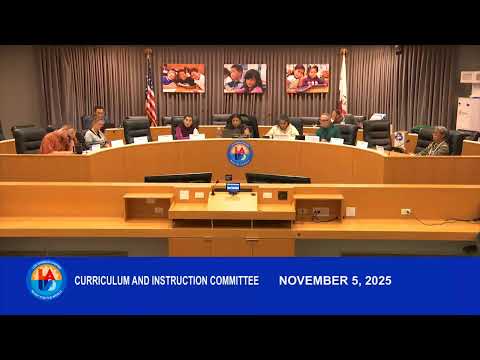
All right. Good afternoon, everyone. The Instruction & Curriculum Committee of the Los Angeles Unified School District heard more than three hours of testimony on the district’s implementation of the FAIR (Fair, Accurate, Inclusive and Respectful) Education Act, with educators and students describing classroom practices that affirmed LGBTQIA+ youth — and community members demanding clearer district guidance, more paid liaisons and transparent oversight of $2 million in funding.
Committee Chair opened the meeting by framing the year’s work: the first half of the school year to identify ideas for curriculum and classroom culture, with two recommendation sets due to the board in February and June.
Teachers who presented said they weave LGBTQIA+ history and perspectives into standard social‑studies and literacy units rather than treating them as add‑ons. "I try to think about my curriculum as more... inclusive and part of the whole narrative of history rather than adding it on," said Danielle Torres, a social studies teacher who described units on Two‑Spirit people, Soladeras in the Mexican revolution and overlooked Holocaust victims, including LGBTQIA+ people. She told the committee that inclusive lessons help students feel "accepted, seen, heard" and improve classroom safety.
Student Alexa Maha, a junior and youth ambassador, said learning queer history made her feel "accepted, seen, heard" and urged the district to make such opportunities widely available. Teachers described concrete classroom work. Katie O'Harn, a fifth‑grade teacher, said lessons helped students identify and push back against homophobic slurs and, in at least one case, made a student comfortable enough to disclose a mental‑health crisis. "Doing this in 2023 was very hard for me and very taxing on my mental health," O'Harn said, urging systems of support for teachers who face sustained backlash.
Presenters and committee members pressed two recurring problems: a lack of easily accessed, district‑sanctioned K–5 lesson sets and inconsistent administrative guidance when students or parents object. Several teachers reported students walking out during lessons and administrators unsure whether to treat the behavior as a protected protest or an attendance/discipline issue.
District staff from the Human Relations, Diversity and Equity (HRDE) team and the Division of Instruction outlined current supports. HRDE leaders said the department provides sample lesson plans, book lists, parent workshops in English and Spanish, and a pilot elementary program called "Everyone Belongs Here" — a five‑lesson series designed to teach respectful language and upstander skills. Christina Vil, an HRDE staff member, described district activities including a National Day of Reading model for inclusive elementary books and training for school‑based liaisons.
Kylie Jackson, history/social science coordinator, reminded the committee that the FAIR Education Act was enacted in 2012 and was incorporated into the state history‑social science framework adopted in 2016; LAUSD’s most recent instructional‑material adoption for history/social science took place in 2017–18 and included FAIR criteria, she said.
But community advocates and several committee members said resources and staffing remain inadequate in practice. Public commenters asked for a district steering committee to oversee the recently allocated $2 million for LGBTQ+ supports, itemized public accounting of how those dollars will be spent, and a timeline to ensure every school has a trained, compensated LGBT liaison rather than a small number of volunteer or lightly compensated site leads. "I do see a lot of tokenism and a lot of peacemeal efforts in the district when it comes to keeping queer and gender‑expansive kids safe," said Sivu Hutchinson of the Women’s Leadership Project.
Other public speakers echoed calls for culturally specific parent workshops, stronger family messaging about what lessons will cover, and clearer opt‑out procedures for contexts where parents seek them. Several speakers said roughly 100 schools currently have a liaison, and speakers asked that the district expand that coverage to all sites and commit to sustainable compensation and supports.
District staff acknowledged the gaps raised by teachers and community members and said they will continue to publish resources in Schoology and expand training. The chair closed by noting committee members will reconvene before January to craft recommendations for the board, and that the request for oversight and transparency on the $2 million allocation was "noted" and will be brought forward.
What happens next: the committee will collect the notes and draft recommendations for discussion in December and for formal consideration in February; community advocates said they will press the board for a steering committee and a line‑item plan for funds to support paid liaisons, expanded student programs and culturally specific family engagement.
Reported authorities and context: presenters repeatedly referenced the FAIR Education Act (state law enacted 2012) and LAUSD’s 2017–18 history/social science materials adoption that incorporated the Act; meeting participants also referenced a Supreme Court case mentioned in the session as "Malmud versus Taylor" when describing parental notice disputes. The district told the committee that FAIR requirements are part of adopted instructional frameworks but that implementation details — especially at the elementary level and around administrative response and family messaging — remain a work in progress.