Get Full Government Meeting Transcripts, Videos, & Alerts Forever!
Get email alerts on the Operating Budget topic
No spam. Unsubscribe anytime.
Honolulu council advances FY2026–27 operating budget after marathon testimony on storms, audits and staffing
Summary
The Honolulu City Council passed Bill 22 (the FY2026–27 operating budget) on second reading after hours of testimony on police retention, proposed cuts to economic programs, homeowners-exemption audits, and ongoing storm-recovery costs; the vote was 8–1. The administration said FEMA public-assistance eligibility appears limited to debris-removal and emergency-response categories.
The Honolulu City Council passed the administration’s FY2026–27 operating budget (Bill 22 CD1) on a second-reading roll call after an extensive public hearing in which residents, labor leaders and agency officials pressed the council on storm recovery, audit practices and staffing priorities.
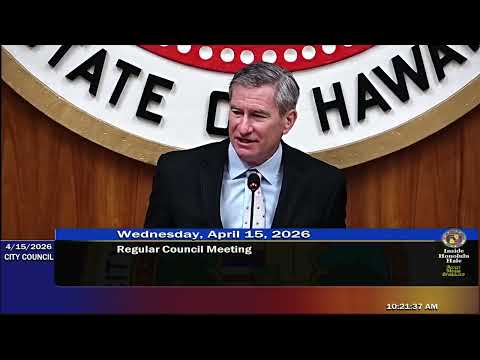
Council members adopted the measure by an 8–1 vote. Chair Tommy Waters called the final tally after roll call: eight ayes and one no. Council members emphasized that passing the budget advances committee work and preserves the council’s ability to refine appropriations before final adoption.
The council heard dozens of testifiers. Jonathan Fry, vice president of the State of Hawaii Organization of Police Officers, urged retention incentives and praised a five-year retention payment for long-serving officers, saying the package “acknowledges the value of institutional knowledge and encourages seasoned officers to stay on the job.” On the floor, Council Member Andrea Tupola and others defended retention and recruitment provisions added to the draft budget to address vacancy and workload concerns in Honolulu Police Department.
Several speakers urged additional resources for storm recovery and criticized proposed cuts to the Office of Economic Revitalization. Resident testimony emphasized continuing needs in hard-hit neighborhoods: “We don’t have time to wait for long procurement cycles,” said Pikechu Shelby Billionaire, a frequent testifier, describing damaged roofs, mold and displacement that local families still face after the storms.
Privacy and process concerns about the homeowners-exemption audit also drew sustained attention. Natalie Wasa told the council she opposed requiring tax returns and utility bills to verify residency, calling the requests “highly sensitive” and urging the city to use public records and driver-license data where possible instead of unsecured email transmission.
On federal assistance and storm costs, Director of Budget and Fiscal Services Andy Kuano told the council that early FEMA guidance indicates public assistance will likely focus on categories A (debris removal) and B (emergency response). Kuano said the administration will exhaust department savings and a $7.5 million provisional disaster fund first and then report back to council before tapping the fiscal stability fund as a last resort. “We are tracking overtime and storm-related expenses by storm code so we can provide clearer numbers,” he said.
Council members repeatedly said they expect additional edits and provisos as the budget moves through committee. Council Member Ka emphasized local projects and urged the administration to return with clarified estimates and tighter reporting on one-time storm expenditures.
The budget now returns to committee for continuing adjustments and is expected to be taken up for final reading after staff and council amendments are reconciled.