Get Full Government Meeting Transcripts, Videos, & Alerts Forever!
Get email alerts on the Zoning topic
No spam. Unsubscribe anytime.
Planner presents 40 proposed zoning text amendments to ease business rules, clarify setbacks and cut pool setback
Summary
Prescott Valley planner Brittany Cleveland presented Zoning Ordinance Amendment 26-001 proposing 40 text changes — about half substantive — including a conditional-use path for outdoor business activities, parking flexibility with engineering justification, revised setback measurement rules, an 8-foot privacy-screen option, and a proposal to reduce pool setbacks to 5 feet.
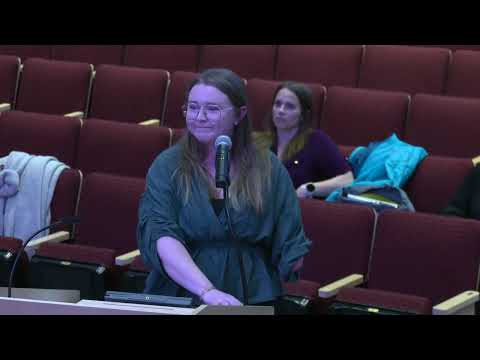
Brittany Cleveland, planner one with Development Services, told the Prescott Valley Town Council at a special study session that staff is proposing Zoning Ordinance Amendment 26-001, a package of 40 text amendments to Chapter 13 intended to make the code clearer and more business-friendly. "This has been a long and iterative process," Cleveland said, summarizing a year of staff work and community outreach.
The amendments fall into two general categories: business-friendly enhancements and clarifying/consistency changes aimed at process efficiency. Cleveland said roughly half of the 40 edits are substantive; the rest are non-substantive clarifications. Key proposals include a conditional-use permit option to allow outdoor activities that the revised code currently prohibits in some zones (examples included daycare outdoor play areas and some restaurant/bar outdoor uses), a pathway for applicants to supply engineering justification to demonstrate adequate parking where the code’s generic requirements fall short, and a change to measure setbacks to the wall or post rather than a mix of wall and dripline measurements.
Cleveland described a set of changes intended to preserve protections while simplifying implementation: accessory-structure setbacks would shift from a dripline-based rule to a 5-foot-to-wall requirement, while retaining a minimum 3-foot dripline buffer so vegetation and root protection remain considered. For residential privacy screening, staff proposes treating privacy screening separately from fences and allowing an 8-foot maximum when the feature meets setback and an "85% screen" standard with limited openings (2 feet of opening for every 4 linear feet) to mitigate visual impacts.
The staff package also adds definitions for self-storage and warehouses and places those uses in an industrial category for consistent treatment. On pools, Cleveland said the town is proposing to reduce the pool setback from the current standard to 5 feet measured from the water's edge to the property line, noting that building-code and engineering requirements would still govern foundation and safety standards.
Council members pressed staff for precision on the pool change. One council member asked whether 5 feet is measured to the house foundation or to the structure; Cleveland replied the 5-foot standard refers to water’s edge to the property line and that additional engineering may be needed in cases where a pool is close to a foundation. She emphasized that building-code requirements — fences, locks, and other safety measures — remain applicable.
Cleveland said staff began the review after the town adopted a rewritten Chapter 13 in late 2024 and then met weekly to work through recurring interpretation questions. She said staff vetted ideas with applicants, community groups (including the Youth Citizen Council and CAFA), neighboring jurisdictions, and other town departments.
Next steps: staff will finalize the adopting ordinance, present the amendments to the Planning and Zoning Commission on May 11, return to the Town Council on May 14 and, if adopted as expected, anticipate an effective date of June 28. Cleveland and other staff members including Frank Cassidy are available for follow-up questions.
The council offered brief praise for staff’s work during the session. The council did not take a formal vote on the package during the study session; the matter returns to the regular agenda for consideration.