Get Full Government Meeting Transcripts, Videos, & Alerts Forever!
Get email alerts on the Housing Element topic
No spam. Unsubscribe anytime.
South Lake Tahoe planners hear draft 2027—2035 housing element outreach presentation; staff warns TRPA rules could limit state policy changes
Summary
City staff told the Planning Commission the city must plan for 291 units under RHNA for the 2027—2035 cycle and outlined programs, site inventory and new state laws; commissioners asked how TRPA regional rules and short-term rental trends could undermine the city's ability to meet those targets.
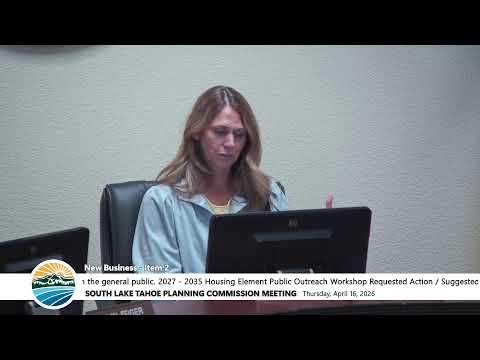
Jessica Wackenhut Lomeli, the City of South Lake Tahoe's housing manager, used a Planning Commission public outreach workshop to outline the draft 2027—2035 housing element and the steps the city must take to secure state certification.
—————————Lomeli said the housing element is a required general-plan element, heavily regulated by state law, and described the update process: an administrative draft, a public-review draft, a 90-day review by the California Department of Housing and Community Development (HCD), resubmission as needed, City Council adoption and final HCD certification.
—————————Lomeli told commissioners: "In the current housing element, which is the 2022 to 2027 RHNA allocation, we had to meet 289 units in the city. And for this next housing element, we're going to have to meet 291 units." She said the RHNA total is broken down by income bands and that the site inventory maps vacant parcels to the income categories they could serve.
The presentation named PlaceWorks as the consultant preparing the administrative draft and listed the housing element's core components: a housing needs assessment, fair housing assessment, sites analysis, constraints analysis, and programs and policies to address gaps.
Lameli and commission members discussed new state laws that affect the seventh-cycle update. "AB 610 requires the seventh cycle housing elements to identify new or strengthened governmental constraints since the prior element," Lameli said, and staff also highlighted SB 786 (which triggers HCD review for missed implementation deadlines) and SB 1037 (which adds penalties for jurisdictions that do not comply with housing-element law).
Commissioners focused questions on whether planned and proposed projects would meet RHNA counts. Staff said the scheduled fourth phase of Sugar Pine Village could contribute roughly 42 new units (timing-dependent) and that a proposed affordable project at 3900 Lake Tahoe Boulevard could add about 72 units once its income breakdown and restrictions are finalized. Staff warned the moderate-income band is typically the hardest to meet because federal and state subsidy programs focus on lower-income categories and rising construction costs make moderate-income for-sale or rental projects difficult to finance.
Mr. Hitchcock (planning staff) updated the commission on previously proposed projects: the Silver Dollar applicant has not moved forward; IHOP-area townhomes are market-rate; and a project owned by Dr. Leeman has an expired TRPA permit and has not advanced. Commissioners raised concerns that privately held parcels and institutional holdings (for example hospital-owned lots) reduce the realistic buildable inventory and that rezoning or redevelopment may be needed over time to meet RHNA beyond the current vacant-parcel count.
Lameli repeatedly warned about alignment issues with the Tahoe Regional Planning Agency (TRPA). "SB 9 is the biggest one," she said, referring to California's lot-splitting law, and explained that TRPA subdivision and other basin regulations limit how SB 9 and some ADU subdivision provisions can be implemented in the Tahoe basin. She said the city may pursue an area plan or code amendments to reconcile TRPA rules with state housing law (program 2A in the current housing element addresses mitigation of TRPA regulations).
Commissioners and staff also discussed how short-term rentals and transient lodging rules affect the local housing supply. Lameli said tracking conversions between vacation-home rentals and long-term rentals is difficult without a rental registry; she recalled that a prior rental-registry proposal did not pass and that other data mechanisms (surveys and new room-night reporting under the upcoming VHR ordinance) will offer partial insight. Staff noted that when VHRs were previously restricted there were about 1,400 VHR listings in residential zones and that subsequent surveys suggested only about 125—150 properties converted to long-term rentals.
The workshop was informational and no formal action on the housing element was taken. Staff encouraged public comment and additional outreach; no members of the public signed up on Zoom for this item and the commission adjourned after scheduling the next meeting.
Next steps: PlaceWorks will finalize the administrative draft, staff will incorporate public input, the city will submit the draft to HCD for review, and the commission and City Council will review revisions ahead of adoption and certification.