Get Full Government Meeting Transcripts, Videos, & Alerts Forever!
Get email alerts on the School Budget topic
No spam. Unsubscribe anytime.
Budget committee reviews how Brookings-Harbor SD 17C develops its annual budget
Summary
Members of the Brookings-Harbor SD 17C budget committee met in a work session to review the district’s budget process, account-code structure, committee roles and quorum rules, and procedural thresholds such as the 15% supplemental-budget trigger.
The Brookings-Harbor SD 17C budget committee held a work session to review how the district develops its annual operating budget and the role committee members will play in that process. The session covered the structure of funds and account codes, public-comment procedures, quorum and voting rules, and when supplemental budgets are required.
The presiding officer opened the meeting, led the Pledge of Allegiance and framed the session as an orientation on ‘‘how we develop the budget and the process that you guys all are involved in.’’ A presenter explained the budget is a written, one-year comprehensive financial plan and emphasized that figures are estimates subject to change as new information arrives.
Committee members were told the budget is governed by the local budget law and related manuals; the presenter referenced a 115‑page manual and the Program Budgeting and Accounting Manual (PBAM) as sources guiding account-code structure. The presenter described common fund categories the district uses: the general fund (major revenue from local taxes and the state school fund), special revenue funds for grants and activity accounts, nutrition accounts (200s), debt service (300s) and capital projects (400s).
The presenter walked through how account codes are layered — fund, function and object — and gave examples of coding conventions cited in the session: state school fund deposits into a 3000s class with an individual code (3101 referenced), federal revenue in the 4000s, and program-level object codes for salaries and purchased services. The chart-of-accounts structure, the presenter said, mirrors statewide PBAM guidance and helps ensure consistency across districts.
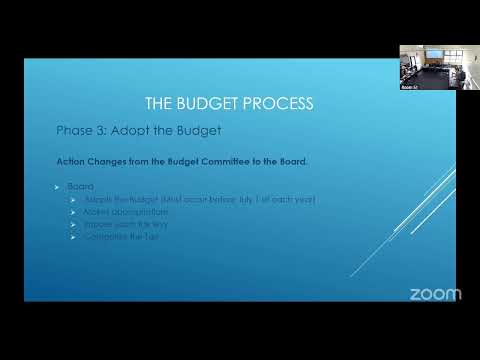
On committee roles, the presenter said the budget committee’s job is to review and approve a proposed budget that the board then adopts; the committee does not set salaries, add or delete programs, or adopt policy. The committee process described: elect officers, hear the superintendent’s budget message, ask clarifying questions, receive public comment and either approve the proposal or schedule additional meetings for further review.
Quorum and voting requirements were stressed: with a full committee the presenter noted the committee needs six affirmative votes to pass a budget (a majority of the full committee). The presenter also explained that changes to an adopted budget generally do not require reconvening the budget committee unless expenditures exceed a 15% threshold, in which case a supplemental budget process would be needed.
The presenter said the adopted budget is posted on the district website and linked from meeting materials and that the district has kept a consistent, readable format for the public. Committee members asked about the schedule for upcoming meetings; the presenter and participants referenced presenting the proposed budget on May 26 and additional meetings expected on Tuesdays following that date.
No formal motions or votes were recorded during this training-style session. The presiding officer adjourned the training portion and noted the regular board meeting would start in about eight minutes.