Get Full Government Meeting Transcripts, Videos, & Alerts Forever!
Get email alerts on the Stormwater Recharge topic
No spam. Unsubscribe anytime.
Prescott Valley and partners test 'Red Rock' stormwater recharge pilot, seek WIFA funding
Summary
Town officials, SRP and engineering partners described a Red Rock field trial testing an infiltration technology (Parana) designed to push stormwater below evaporative zones and into aquifers; a WIFA grant funds a 22–26 month evaluation and Prescott Valley has applied to replicate a sister trial locally.
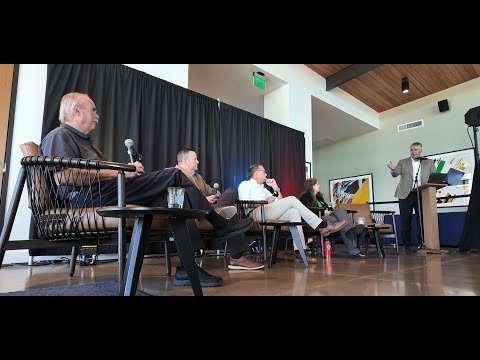
Prescott Valley officials and water-industry partners described a field trial they say could turn stormwater from a nuisance into a local water resource by moving surface water quickly below the zone of evaporation.
Hunter Moore, a member of the Prescott Valley team that convened the project, said the group is testing how to “move water underground faster to avoid evaporation and to reach the local aquifer quickly.” The panel outlined a demonstration at Red Rock that compares an unenhanced control basin with an enhanced basin using a proprietary infiltration technology developed by a company referred to in the presentation as Parana.
Why it matters: Tracy Lund, Water Resources Adviser for the Town of Prescott Valley, reminded listeners that the Prescott Active Management Area has been declared out of safe yield by the Arizona Department of Water Resources, with the aquifer estimated to be declining about one foot per year. "Our objective as stewards of the aquifer is to try to get water into the aquifer," Lund said, framing the pilot as a potential tool to improve long-term water security.
Panelists described the technical basis for the experiment and the safeguards they say distinguish this effort from prior policy-driven proposals. Don Clark, a senior principal and geotechnical engineer with Terracon, cited historical studies and his own analyses: “95% of the rainfall that falls on the state of Arizona is lost back out to evaporation right now,” he said, and added that infiltration must reach depths on the order of tens of feet to avoid being drawn back to the surface.
What they are testing: The Red Rock setup uses two basins spaced hundreds of feet apart (the panel described bottom areas of roughly 50 by 50 feet, top footprints near 82 by 82 feet and depths about 4 feet). The northern basin is a control; the southern basin is enhanced with the Parana technology. The team is pumping groundwater to rapidly fill the basins to perform controlled tests, monitoring pond decline and using moisture sensors placed as deep as 45 feet to track subsurface movement. Terracon compiled a finite-element model the trial is intended to validate.
Water-rights and legal safety: Panelists emphasized a site-by-site review to avoid impacting appropriated surface flows. Tracy Lund said the project team distinguishes locations that “hit a natural channel” (which may be subject to downstream appropriations) from those where additional local recharge may be available. Lucas Shaw of Salt River Project (SRP) said SRP’s involvement reflects an interest in verifying the science before any policy changes: "Let's let the science guide where we go," he said.
Funding and timeline: The team secured a Water Infrastructure Finance Authority (WIFA) grant to fund the Red Rock demonstration and described that award as covering a 22–26 month study. Prescott Valley has applied to WIFA for a second, local field trial in the Ponghorn development and said construction could begin within months if funded.
Uncertainties and next steps: Panelists stressed the experimental nature of the work. Ricardo Aguirre (West Consultants) described a working metric called 'urban enhanced runoff'—the increased runoff volume due to development that could be captured—and said initial analyses find that this volume often is smaller than on-site retention requirements but may still be harvestable. The team said it will refine models with the field data and that policy changes should follow robust, replicated science rather than assumptions.
The town said it has committed contingent funds and partners indicated they will continue collaboration; the panel closed by urging additional measurement, independent verification and careful site evaluation before broader deployment.