Get Full Government Meeting Transcripts, Videos, & Alerts Forever!
Get email alerts on the Voter Registration Residency topic
No spam. Unsubscribe anytime.
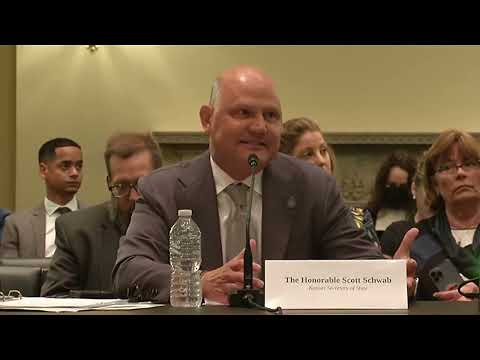
Representative Loudermilk Presses Secretary Schwab on Cross-State Registration, Vouching and Provisional Ballots
Summary
At a House committee hearing, Representative Loudermilk questioned Secretary Schwab about how states determine voter residency, the role of ERIC and change-of-address databases in roll maintenance, and Minnesotas vouching rules and lack of provisional ballots, which can mean votes later found ineligible may still count.
Representative Loudermilk questioned Secretary Schwab at a House Administration committee hearing about how states identify cross-state voter registrations and how vouching and provisional-ballot rules affect whether votes are counted.
Loudermilk opened the exchange by arguing that "election integrity is something that has to be proactive," saying problems discovered after an election cannot be undone. He asked whether a person registered in one state but residing in another should be considered an eligible voter in the registering state.
Secretary Schwab responded that residency definitions are "very loose" across jurisdictions and that registration in one state does not by itself prove continuous residency. "Not necessarily, because we don't have a residency definition. It's very loose," she said, explaining that states typically use data exchanges such as ERIC and national change-of-address information to detect moves but that using those tools carries costs and administrative burdens.
The two exchanged hypothetical scenarios about voters who move (for example, from Kansas or Minnesota to Florida) and remain registered in their previous state. Schwab said automated checks, including change-of-address records and, when available, ERIC, give "a good chance" of discovering such moves. "If they're a member state of ERIC, we absolutely would," she said.
Loudermilk also pressed Schwab on the vouching process used in some jurisdictions when a registrant lacks standard proof of residence. Schwab clarified that vouching is handled at the local (county) level: the voucher must be an eligible registered voter, the vouched-for person signs an oath, local officials log the vouching, and county staff perform post-election spot checks to verify eligibility. "The person signs an oath," she said, describing the local log and subsequent verification steps.
On provisional ballots, Schwab stated that Minnesota does not use them because it is NVRA-exempt: "No, because we're NVRA exempt. We don't do provisional ballots in Minnesota." She and Loudermilk discussed the implication that, under that practice, ballots cast by people who are later found not to have been eligible could nevertheless count, depending on when and how verification occurs.
Schwab emphasized a key limit of vouching: it covers only residency. "Vouching is only for residency," she said. "No one is vouching for someone's citizenship, age or anything else." She noted that someone might be a citizen and of age but still have voted in the wrong place if they do not actually live where they say they do.
The exchange highlighted differences in state practices (use of ERIC and change-of-address checks, handling of provisional ballots) and the dependence on local procedures for vouching verification. The transcript ends mid-utterance during a follow-up about potential ineligibility due to felony status.
The committee's questioning in this segment focused on how states balance voter access with roll accuracy, and on the practical limits of post-election verification when registration or vouching practices vary by jurisdiction. The hearing record for this exchange runs from the first question about residency (SEG 028) through the last available segment (SEG 138).