Get Full Government Meeting Transcripts, Videos, & Alerts Forever!
Get email alerts on the Emergency Management topic
No spam. Unsubscribe anytime.
Oxnard fire chief urges council to adopt 2026 emergency plan, formalize ASPCA pet-aid agreement
Summary
Fire Chief Alex Hamilton told the committee the City of Oxnard’s 2026 Emergency Operations Plan (base plan) updates hazard assessments, clarifies EOC roles and incorporates state mandates on multilingual communications and access needs; he also presented an ASPCA mutual-aid agreement to support pet sheltering, with staff saying there is no fiscal impact.
Alex Hamilton, fire chief for the City of Oxnard Fire Department, told the committee the city should adopt the 2026 Emergency Operations Plan base plan and authorize the mayor to sign a letter of promulgation making the plan effective.
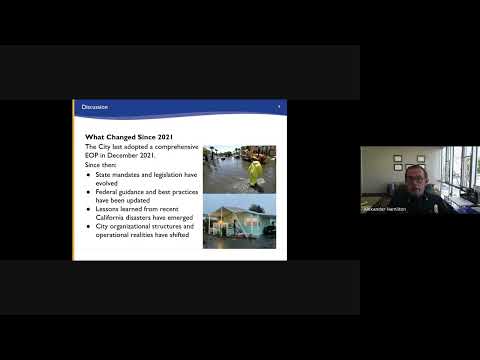
“This plan establishes the city's emergency management framework,” Hamilton said, describing the update as a five-year cycle and noting the last full update was in December 2021.
The base-plan update, Hamilton said, is intended to ensure continued compliance with state and federal incident management systems and the California Emergency Services Act, preserve eligibility for FEMA public assistance and hazard-mitigation grant programs, and improve coordinated preparedness, response and recovery across city departments. He warned that falling out of compliance could jeopardize disaster assistance and reimbursement.
Hamilton outlined the EOP’s structure and said only the base plan requires formal council adoption; operational appendices and annexes would be maintained administratively. Key changes in the 2026 base plan include separating the base plan from appendices, updating the hazard and threat assessment and maps to reflect current risks, revising emergency operations center roles and activation procedures, and strengthening intergovernmental and community partnerships.
Hamilton highlighted new state mandates that the plan incorporates, including expanded multilingual communications and provisions for access and functional needs. He also emphasized that animal sheltering is now a required component of shelter operations: “Pets is now a big part of emergency sheltering operations,” Hamilton said, adding that the city must plan to provide for people’s pets to avoid life‑threatening choices in disasters.
As a related action item, Hamilton presented a mutual-aid agreement with the American Society for the Prevention of Cruelty to Animals (ASPCA) to provide animal support when shelters are activated. “This allows us to have the ASPCA come and help us when we activate emergency shelters because we have to provide for people's pets,” he said.
Hamilton told the committee there would be no fiscal impact from adopting the EOP or from entering the ASPCA agreement as presented. He and Emergency Manager Candy Campbell offered to answer questions from committee members.
The committee received the presentation; the transcript records a recommendation that the committee recommend City Council approve the EOP base plan and authorize the mayor to sign a promulgation letter, and it records presentation of the ASPCA mutual-aid agreement. The transcript does not record a council vote or formal adoption during this meeting. The next procedural step is for the committee to forward the recommendation to City Council for consideration.