Residents urge Multnomah County to use $16M for permanent housing and restore mental‑health and violence‑response programs
Summary
Public commenters at Tuesday's board meeting urged the county to allocate $16 million of unused housing funds to permanent housing and housing‑first initiatives, to restore direct clinical services cuts that would eliminate culturally responsive staff roles, and to retain a gun‑violence behavioral health response team.
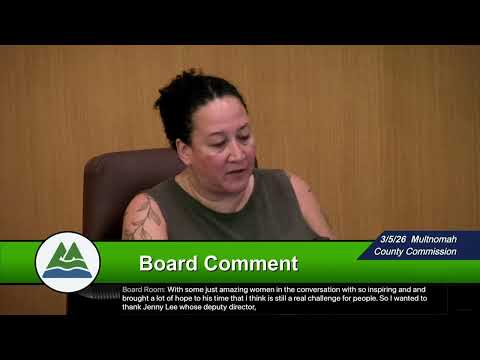
During the public‑comment portion of Tuesday’s Multnomah County Board meeting, multiple residents and community advocates urged the county to prioritize long‑term housing solutions and to reverse proposed cuts to mental‑health and violence‑response programs.
Sarah Chedister, a Portland State University student and community advocate, asked commissioners to use $16 million in unused housing funds to expand affordable housing and strengthen a housing‑first approach rather than further shelter expansion. "Using the available funds to put people into permanent housing and preventing the loss of houses in the first place serves as a long‑term solution to end homelessness," she told the board.
Amy Griffin, speaking on her own time as a county employee, asked the board to restore proposed eliminations to direct clinical services that she said would cut culturally and linguistically responsive programs and eliminate staff and supervisory roles, disproportionately harming BIPOC and LGBTQIA+ clients. Griffin said the cuts would remove programs that provide vital mental‑health services and warned of the downstream human and fiscal costs of reducing prevention efforts.
Candace Himenez, a Multnomah County resident and tribal citizen of the Confederated Tribes of Warm Springs, urged the board not to eliminate the gun violence behavioral health response team in the FY27 budget. Himenez described the program—launched as a pilot in 2022—as one of the few culturally grounded, clinically licensed teams serving youth and families affected by gun violence and said removing it would weaken a broader prevention strategy.
Other public speakers asked the board to continue supporting community resource programs that help families remain stable, and one speaker urged the commissioners to pursue body‑worn camera implementation with auditing access to footage for oversight. Charles Bridge Johnson asked the county and city to inspect shelter sites in the wake of a recent fatal fire tied to a shelter operator and to ensure trauma‑informed supports and safety inspections are available in contracted facilities.
Board members acknowledged the public testimony and said they would consider the concerns as budget and program decisions proceed.
AI generated
The text on this page is AI generated. Summaries, highlights, analysis, and video transcripts are all produced from the original source material.
AI can make mistakes, so if you spot one, and we will fix it for everyone.
Note: the source content is unaltered by us. Any content source we link to, be it a video, an audio recording, or a document, is presented exactly as its publisher released it. That publisher is usually a government body, sometimes an individual official or another organisation.