Get Full Government Meeting Transcripts, Videos, & Alerts Forever!
Get email alerts on the School Facilities topic
No spam. Unsubscribe anytime.
Chicago Public Schools details multibillion‑dollar facility backlog, seeks public input on FY27 capital priorities
Summary
CPS officials presented their FY27 capital‑planning process, saying an annual $400 million is needed just to avoid further deterioration and that immediate building repairs are roughly $3.7 billion; the district outlined 12 budget categories and asked the public to complete a survey open through April 30.
Chicago Public Schools officials laid out the district’s FY27 capital‑planning process during a public session, describing a multibillion‑dollar backlog of building repairs and asking residents to weigh in through an online survey.
“An annual run‑in‑place funding level of $400 million is required to avoid further deterioration every year,” said Ivan Hansen, chief facilities officer for CPS, who led the presentation. He said the district maintains more than 62 million square feet of school buildings — including structures more than 150 years old — and that prioritization is necessary because available funding varies year to year.
Hansen summarized cost estimates for major repair categories based on recent facility assessments: immediate critical needs (roofs, windows, heating and cooling) are about $3.7 billion; long‑term critical needs about $6.6 billion; ADA accessibility upgrades roughly $600 million; and broader facility upgrades more than $5.3 billion. He said those category totals include only the cost to do the work, and do not include programmatic expenses.
Ariel Vodka, the district’s director of renovation and capital planning, said the FY27 planning draft includes 12 priority budget categories that largely continue from prior years: roof/envelope, mechanical/electrical/plumbing systems, restrooms, parking lot repairs, playgrounds, modular buildings, IT infrastructure, security improvements, student recreation and athletic resources, sustainability/energy projects, space‑efficiency reviews and programmatic classroom investments.
“At a macro program level, embedding sustainable principles into our standards guides materials and technology,” Vodka said, noting the board adopted a green resolution that includes four new solar projects (two roof‑mounted and two ground‑mounted).
Officials said the capital recommendations are driven by three inputs: the most recent facility condition assessments (visual, non‑destructive inspections posted on cps.edu), the district’s Opportunity Index (an 11‑factor equity metric updated with community and research input), and available funding. Hansen said the district posted updated assessments in spring 2024 and is conducting another round of assessments to complete by year‑end.
Hansen and Vodka described how the Opportunity Index and condition assessments are used together to prioritize projects and that CPS continues to pursue outside funding — including tax‑increment financing, aldermanic funds, state and federal grants, and partnerships such as Space to Grow with the Department of Water Management and the Metropolitan Water Reclamation District — to supplement capital dollars.
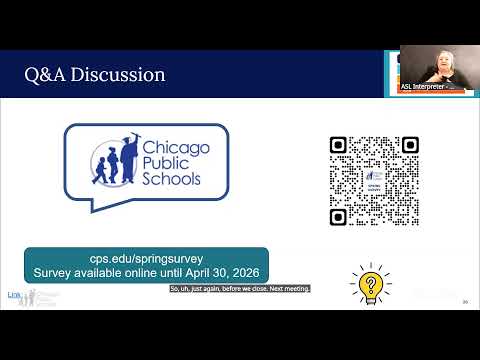
Officials encouraged parents, school leaders and community members to complete the FY27 survey; they said survey responses informed prior investments (roughly $2 billion invested between FY21 and FY26) and will shape the recommended project list that CPS will present at public hearings before the board considers approval this summer.
During the Q&A, staff answered campus‑specific questions about site flooding and field replacements, citing the large capital costs required for turf replacement and noting CPS will continue to seek external funding for costly site projects. Officials urged community members to submit project priorities via the survey and through local school councils and principals.
The district announced two in‑person follow‑up meetings on April 21 (1:00 p.m. and 5:30 p.m.) at the Coleman office (4700 S. State St.), with all meetings livestreamed and recordings and materials to be posted on CPS’s website. The public survey will remain open through April 30.
Next steps: CPS will compile survey feedback and present a recommended FY27 capital project list at public hearings, then seek board approval this summer.