Get Full Government Meeting Transcripts, Videos, & Alerts Forever!
Get email alerts on the Rezoning topic
No spam. Unsubscribe anytime.
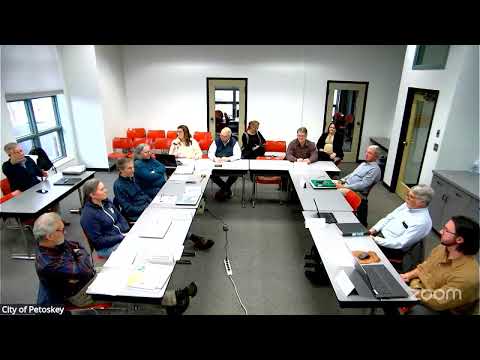
Petoskey Planning Commission recommends rezoning of 224 Michigan Street for adaptive reuse of historic Bell Tower building
Summary
The Planning Commission voted to recommend that City Council rezone 224 Michigan Street from OS (office/service) to B2B (mixed‑use corridor) to allow an adaptive‑reuse project called the Bell Tower that would host small events and community programming. Commissioners cited master plan consistency but debated parking and neighborhood impacts.
Petoskey — On April 15, 2026, the Petoskey Planning Commission voted to recommend that the City Council rezone 224 Michigan Street from OS (office/service) to B2B (mixed‑use corridor) to accommodate the Bell Tower adaptive‑reuse project.
Lindsey Dotson, the owner and applicant, told commissioners the conversion would reactivate a long‑vacant former church as a flexible, community‑oriented venue for small events, classes and wellness programming. "We are requesting rezoning to allow a mixed‑use designation that better fits the building and the downtown adjacent location," Dotson said during her presentation, explaining that the building’s sanctuary‑scale layout is not practical for traditional office use.
Staff and commission members reviewed the Livable Petoskey Master Plan and concluded that the B2B designation aligns with the plan’s neighborhood mixed‑use guidance. A staff memo noted the property is listed on the National Register of Historic Places and that B2B zoning explicitly allows public assembly uses that the current OS classification does not.
Public commenters delivered mixed views. Riley Turcott, owner of an adjacent professional office building, opposed adding 224 Michigan to the parking‑exempt district, calling out proximity of private lots, plowing and maintenance costs (he estimated $40–$150 per spot per year) and the difficulty of policing event parking. "I do oppose the parking exemption," Turcott said. Everett McCartney, representing a nearby dance building, also warned about spillover parking and urged the commission to consider neighborhood impacts. By contrast, Suzanne Perry, a frequent downtown visitor, and remote commenter Lindsey Walker said they supported Dotson’s plan and emphasized downtown’s shortage of affordable mid‑size meeting spaces.
Commission debate emphasized two themes: supporting preservation and economic reuse of an old structure and limiting potential parking and neighborhood impacts from new event‑oriented uses. Commissioners discussed whether to approve rezoning alone or pair it with a broader expansion of the parking‑exempt district; several members preferred deciding on the applicant’s parcel first. A commissioner noted contamination concerns on the adjacent dry‑cleaner lot (the Hooker parcel) that could affect feasibility of new underground parking there.
A motion to recommend approval of rezoning parcel 52‑19‑06‑27‑801‑3 at 224 Michigan Street (applicant listed as Great Lakes Housing Preservation LLC in the motion) carried on a roll‑call vote. The transcript records affirmative votes from Commissioners Smith, Newman, Robson, Meridian, Fried and Demmer and a recorded no vote from Commissioner Paul; one commissioner’s vote was not clearly transcribed. The commission’s recommendation now goes to the Petoskey City Council for final action.
The commission did not adopt conditions limiting particular B2B uses at the time of the motion; commissioners said those use‑level concerns remain part of the council review and future site‑specific approvals.
Next steps: The Planning Commission’s action is a recommendation; the City Council will consider the rezoning at a future meeting and the applicant may pursue the related parking‑exempt application separately if council action is favorable.