Get Full Government Meeting Transcripts, Videos, & Alerts Forever!
Get email alerts on the Septic Composting Pilot topic
No spam. Unsubscribe anytime.
Falmouth board approves monitored pilot allowing composting toilet in lieu of immediate nitrogen system
Summary
The Board of Health approved a pilot permitting an on‑site composting toilet and limited conventional flush use as an alternative to installing an I/A nitrogen‑reducing septic system, conditioned on monthly nitrogen monitoring for 24 months, off‑site removal of residuals by a licensed hauler and a deed restriction.
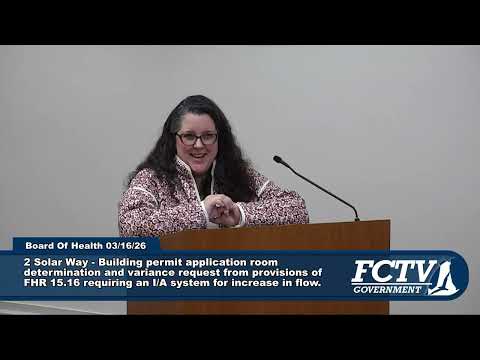
The Town of Falmouth Board of Health voted March 16 to allow a monitored pilot that accepts a homeowner’s existing composting‑toilet system in place of immediately installing a conventional nitrogen‑reducing on‑site system when a building permit shows an increase in bedroom count.
Health agent Scott told the board the building permit would increase flow because it creates a new bedroom; under the town’s nitrogen rules an I/A (innovative/alternative) nitrogen‑reducing system is normally required when flow increases. The homeowner said composting toilets have been in use at the property since 2002 and that a contractor (nutrient network) periodically removes residuals; board members sought clarity on how liquids and solids are managed and whether off‑site processing would achieve meaningful nitrogen removal.
After a lengthy exchange about vacuum‑flush and urine‑diversion options, testing needs and state recognition of particular technologies, the board moved to approve the composting system as equitable to the best‑available technology provided several conditions are met: the primary dwelling must use an approved composting toilet installed and maintained per manufacturer records; a single conventional toilet may be permitted if it discharges to the compost unit (vacuum‑flush preferred); no residuals from the composter may be discharged to the on‑site system; the owner must maintain a service contract with an approved hauler for residual removal; monthly sampling of septic effluent for total nitrogen must be conducted for 24 months and submitted to the board within 30 days of each result; if monitoring exceeds 10 milligrams per liter total nitrogen or if the composter is not properly maintained, the board may require installation of a DEP‑listed nitrogen‑reducing on‑site system; and a deed restriction must be recorded limiting approved bedrooms and plumbing fixtures and requiring continued maintenance and monitoring.
The motion passed in a voice vote. The board directed staff to send a formal written decision and the monitoring/maintenance requirements to the homeowner and to report monitoring results through existing county channels as appropriate.
The board and staff said the pilot is intended both to provide data the town can share with state regulators and to explore lower‑cost options for nitrogen control where composting systems are properly maintained and residuals are removed and processed off‑site.