Get Full Government Meeting Transcripts, Videos, & Alerts Forever!
Get email alerts on the Energy Infrastructure topic
No spam. Unsubscribe anytime.
Santa Fe County panel approves two large solar-plus-battery CUPs, adds reclaimed-water requirement for construction
Summary
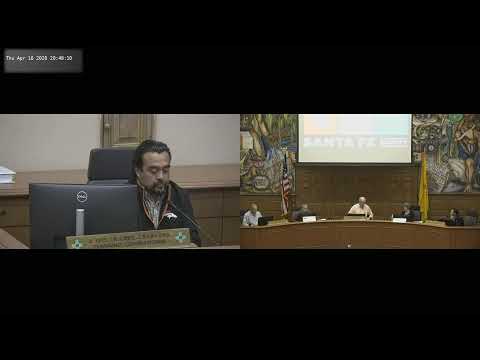
The Santa Fe County Planning Commission approved two consolidated conditional-use permits April 17 for a large commercial solar and battery-storage project after lengthy technical presentations and public comment; commissioners added a condition requiring reclaimed water for construction dust control amid community concerns about groundwater in the Estansia Basin.
The Santa Fe County Planning Commission on April 17 approved two consolidated conditional-use permits for a large commercial solar and battery energy storage project in southeastern county, imposing staff-recommended conditions and adding one requirement that all water used for construction dust control be reclaimed water.
The project — presented by Glo Energy LLC/Lineia Energy as a two-phase commercial solar facility with associated battery energy storage (cases 255180 and 255190) — would place arrays and storage systems on privately owned parcels accessed from NM41 in Commission District 3. Applicant testimony described Phase 1 as about 199 megawatts of solar with 199 megawatts of storage across roughly 1,932 acres and Phase 2 as about 150 MW plus 150 MW on roughly 960 acres; the applicant estimated construction would begin in late 2027 with commercial operation by 2029.
Staff and applicant materials provided to the commission included an environmental impact report, biological and cultural surveys, geotechnical work, a noise analysis, a hazard-mitigation analysis and a decommissioning plan. County staff concluded the application met the Sustainable Land Development Code (SLDC) conditional-use criteria subject to the proposed conditions of approval and third-party review. The commission’s approval carries those conditions and the additional reclaimed-water requirement for construction dust suppression.
Why it mattered
County staff and the applicant framed the project as consistent with Santa Fe County’s Sustainable Growth Management Plan and state renewable-energy policy, pointing to transmission access on PNM lines and the role of battery storage in grid reliability. Supporters who spoke during the public hearing said the project would deliver jobs, tax revenue and lower system emissions. Opponents and several commissioners pressed the applicant on groundwater use, emergency response, battery safety and long-term decommissioning obligations.
What staff and the applicant said
Dominic Cisneros, Santa Fe County Building and Development Services supervisor, summarized the entitlement process and the SLDC criteria for a CUP, presented the project locations and listed the studies submitted for public review. Cisneros told the commission the application had been through third-party review and that staff found no code-level conflicts subject to conditions and agency approvals.
Andrew Davidson and other Lineia/ Glo Energy representatives told the commission the project had interconnection positions with the utility and that project economics could be supported with or without federal tax credits, though credits reduce the cost threshold. The applicant described construction impacts as temporary and manageable, with a peak construction workforce estimate of about 250 workers and traffic-management plans to avoid peak-hour impacts on NM41. The applicant emphasized planned coordination with the county fire prevention division and the obligation to meet NFPA and county fire-code requirements, and presented a decommissioning plan with a financial guarantee to cover site restoration at end of life.
Key points of debate
- Water: The project sits in the Estansia Basin, a closed groundwater basin. Applicant materials estimated up to 4 acre-feet per year of water for ongoing operations and presented a conservative theoretical maximum of 67.4 acre-feet for the entire construction period only under an implausible ‘max-every-day’ scenario. The applicant said construction water would be trucked bulk water from local providers (the record cites a ready/willing letter from Entronosa Water Association), and that an on-site or converted well would be used for operations only after state-engineer approval. Several neighbors asked the commission to require stronger assurances (emergency funds, a district water system or guaranteed supplies) before approving the permit.
- Fire and battery safety: Applicant engineers said the battery energy storage system (BESS) would use lithium-iron-phosphate (LFP) chemistry, which suppliers and the applicant characterized as having a lower risk profile than some other chemistries. The applicant and the battery-safety consultant described multi-layered detection and mitigation systems and said a site-specific Hazard Mitigation Analysis and equipment-level UL 9540/855 compliance documentation would be produced once final equipment is selected and prior to building permit approval. County fire officials told the commission they would review final HMA and emergency-response plans during the development-permit process and that local volunteer/staffed stations would be trained in coordination with the applicant.
- Decommissioning and bonds: The applicant provided a draft decommissioning plan and said the final bond amount would be certified by a licensed engineer based on final construction design before recordation of the CUP site development plan; the county code requires that guarantee and periodic reassessments through the facility life.
Public input
Public-comment speakers included local residents and statewide organizations. Several residents who live near the site raised water-supply and habitat concerns and asked for protections in case wells go dry. Environmental and veterans groups and other supporters emphasized climate and economic benefits, grid reliability and the importance of permitting standards to reduce unwanted impacts.
Outcome and next steps
After an executive session for deliberation, the Planning Commission returned to the public meeting and approved both consolidated CUPs by roll-call majority, adopting the staff-recommended conditions and adding one explicit requirement: the applicant must use reclaimed (non-potable) water for all construction dust-control activities. The commission’s final order and the recorded CUP site development plan will be required before the applicant may seek building permits; final, equipment-specific hazard analyses and fire-department approvals will be reviewed as part of that later stage.
What to watch for
- Finalization of the site development plan and recorded CUP documents, including the applicant’s demonstration of compliance with conditions such as access permits, flood-zone coordination and third-party review reimbursements. - Final Hazard Mitigation Analysis and UL 9540/855 equipment certification submitted to the county fire prevention division during development-permit review. - Water-right approvals (if a new operations well is needed) or ongoing supply arrangements with a bulk water provider and whether the reclaimed-water requirement leads to a feasible construction-water plan.
Speakers quoted in the hearing
“Two access driveways from NM41 … construction traffic will be temporary for approximately 18 months. The peak will be up to 250 workers,” (Dominic Cisneros, staff). “We believe that our project meets the criteria for CUP approval and is consistent with the zoning requirements,” (Andrew Davidson, applicant). “We want reclaimed water used for construction,” (Commissioner-added condition; commissioners debated water options during questioning).
Ending
The commission’s approval moves the project to the next, post-CUP permitting stage, where applicants must satisfy building-permit, fire-safety and site-recordation requirements before starting construction. Project opponents said they will continue to press for more binding water protections and clearer equipment-level safety documentation; supporters said the approval advances county and state renewable-energy goals while creating jobs and tax revenue.