Get Full Government Meeting Transcripts, Videos, & Alerts Forever!
Get email alerts on the Utilities topic
No spam. Unsubscribe anytime.
Committee questions ComEd AMI mesh agreement and smart-meter rollout, raises access and outreach concerns
Summary
Waukegan aldermen questioned staff about a proposed joint-use agreement with ComEd to expand an AMI mesh network for smart meter reads (effective June 2026–2041). Staff said the first-year rollout targets 1,000 readout units, with 5,000 the following year; aldermen pressed staff on in-home access, outreach in English and Spanish, battery life and conflicting meter counts.
City staff and committee members discussed a proposed joint-use agreement with ComEd to expand an advanced metering infrastructure (AMI) mesh network to capture water usage data from customer meters.
Staff explained the agreement covers the network that reads a device mounted on the outside/top of existing meters; they said the work does not require shutting off water and that the first-year rollout would replace readout devices on 1,000 meters with 5,000 planned the following year as part of a five-year deployment. Staff described the rollout as necessary to move to new meter-reading software and to stop door-to-door manual reads.
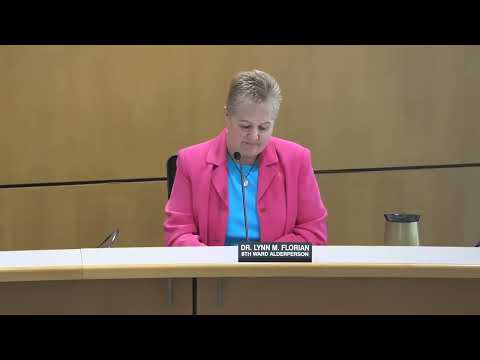
Alderman Florian said he was not present for earlier briefings and asked how the city plans to make the rollout “as painless as possible,” citing prior problems with access during lead-line work and residents who do not answer their doors. Water department staff said in-home access will be required in many cases because some meters are located inside basements; staff added that the device on top of the meter is the part being changed and there is no need to shut off water for the exchange.
On cost and procurement, staff said ComEd’s joint-use arrangement would be charged at about $2,000 per 1,000 meters (as presented to the committee) and that the city has started 100 changeouts. Staff described supply/backlog constraints for the equipment: obtaining new batteries and mounts took months, which is why the city is rolling out only 1,000 in year one. Committee members suggested outreach via ward meetings, Facebook and a Spanish/English letter; Alderman Martinez asked specifically about marketing in both languages and staff said they will coordinate with public relations and send letters in English and Spanish.
Committee members also discussed options for prioritizing installations, such as tying meter replacement to permit activity or real-estate closings, but staff said a roll-out list will be developed with the meter-reading software vendor and that early installs may be randomly selected or selected by consumption metrics. Committee members raised two different meter counts during the discussion: staff at one point said "a little over 21,000" meters exist and later clarified the total active meters are 20,573, noting that meter counts reflect devices not properties (apartment buildings may have a single meter for multiple units).
Staff said a customer portal will be available to let residents see near-real-time water usage once the system is fully deployed and that a signup/response mechanism will be included in mailings. The committee did not take formal action on the ComEd agreement at this meeting; staff said they will return with a presentation and more information once the software transition is complete.
The meeting adjourned at 6:16 p.m.