Get Full Government Meeting Transcripts, Videos, & Alerts Forever!
Get email alerts on the Town Clerk topic
No spam. Unsubscribe anytime.
New Canaan Charter panel advances redline on town-clerk provisions after debate on assistants and term lengths
Summary
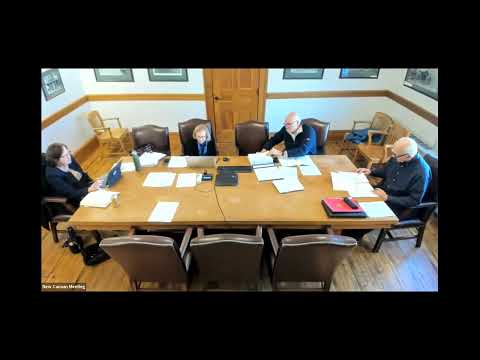
Group One of the New Canaan Charter Revision Commission voted 3–0 to forward a redlined draft of Article 19 (town clerk) to the full commission after debating whether assistant town clerks should be appointed, who should set their compensation, and whether the clerk should remain elected or become appointed.
The New Canaan Charter Revision Commission’s Group One voted March 18 to forward a redlined draft of Article 19 — the section that governs the town clerk — to the full commission after a lengthy discussion over assistants, compensation, and whether the job should remain elected.
The decision to advance the draft came after commissioners reviewed responses from the town clerk to 15 written questions and debated several structural choices. Steve Pace, the meeting’s acting coordinator, moved to send the redline version up for full-commission consideration; the motion passed by voice vote, 3–0.
Why it matters: Article 19 defines how the town clerk’s office operates, who appoints or supervises deputies, and how continuity is preserved when the elected clerk leaves. Commissioners said the way the charter frames assistant appointments and salary-setting could materially shape hiring, turnover and institutional knowledge at town hall.
Commissioners discussed three linked issues. First, whether assistant town clerks should be appointed by the town clerk or require approval from the board of selectmen. The redline proposed adding a sentence allowing “with the approval of the board of selectmen, the town clerk may appoint an assistant town clerk who, having taken the required oath, shall in the absence or inability of the town clerk perform all duties as town clerk.” Supporters said the wording preserves clerk responsibility while building in selectmen oversight; critics worried it could undermine the town clerk’s functional independence.
Second, the group debated who should set assistant-clerk compensation. Some members noted statutory practices and budget processes that place pay decisions in broader town budget procedures; others argued standard town employment channels should handle assistant salaries rather than the charter.
Third, commissioners revisited whether the role should remain an elected office or become appointed. Several members, including Andrew Brooks, urged caution about making a recommendation at the subgroup level, saying the question is larger than Group One’s charge: “This is way beyond the scope of the Charter Revision Commission,” Brooks said during debate about the limits of the panel’s remit. Other members emphasized the value of long-serving elected clerks and the difficulty of recruiting experienced candidates if the office remained a frequent two-year election.
The group did not adopt a recommendation on whether the clerk should remain elected; the motion they approved sent the redline text upward while leaving the appointment/election question open for the full commission’s deliberation. Members also agreed to follow up on statutory language and asked one commissioner to verify relevant Connecticut statutes before reopening the clause on assistant appointments.
What’s next: The redlined draft of Article 19 will be reviewed by the full Charter Revision Commission. Commissioners said they will report back if statutory research changes the proposed language.