Get Full Government Meeting Transcripts, Videos, & Alerts Forever!
Get email alerts on the Health And Safety topic
No spam. Unsubscribe anytime.
PlaceWorks presents Health and Safety element; GPAC presses for clearer implementation, evacuation and senior protections
Summary
PlaceWorks told Lake County GPAC that wildfire and smoke pose the county’s greatest vulnerabilities; members pushed for more actionable timelines, clarity on what 'require' means in policy language, stronger protections for older adults, tribal communities and residents without smartphone access, and clearer links to funding and enforcement.
PlaceWorks principal Tammy Seal presented Lake County’s draft Health and Safety element on April 17, describing the element’s legal requirements, supporting technical appendices and 13 draft goals addressing wildfire, flooding, evacuation, extreme heat, hazardous materials, and other hazards.
"Wildfire and wildfire smoke create the most vulnerabilities countywide," Tammy said, summarizing the climate vulnerability analysis prepared as an appendix to the draft element. She said the team prepared three technical studies: a background report, a countywide evacuation study, and a climate vulnerability analysis to satisfy recent state requirements (including SB379, SB99 and AB747) and to inform evacuation planning, evacuation‑constrained parcel analysis and policy recommendations.
PlaceWorks highlighted five evacuation scenarios used in the analysis (three wildfire perimeters, a Clear Lake‑area flood scenario, and a landslide scenario) and recommended actions including improved secondary access, expanded evacuation assistance for vulnerable residents, better evacuation communications and coordination with emergency operations plans.
GPAC members focused questions and criticisms on implementation detail rather than hazard identification. Committee members repeatedly asked what the word "require" means in draft policies — whether it implies county ordinances, zoning changes or other enforceable standards — and asked staff to identify named departments, timelines and funding sources for requirements.
"If there is a requirement, then it will be reflected in a zoning code update," Maria said, describing the typical implementation pathway, while other members warned about unfunded mandates and the county’s limited fiscal capacity.
Committee members raised repeated concerns about older adults, people with disabilities and households without smartphones or internet access. Betsy Khan pressed for concrete measures to ensure notification and transport, noting that "40% of the population of the state of California does not have smartphones," and urging specific commitments rather than only aspirational language. In response, Tammy highlighted two draft actions that specifically address vulnerable residents: HS1H, which calls for coordination with Lake Transit to provide transit services to and from resilience centers for older adults and people with disabilities, and HS1I, which calls for coordination with local health providers to ensure continuity of essential medical services during and after disasters.
Tribal members and GPAC participants asked for clearer, actionable protections for tribal cultural resources and for recognition of localized contamination and brownfields (the meeting referenced the Elm/Elim colony and Superfund‑adjacent concerns). Several members recommended a discrete tribal chapter or clearer cross‑references so tribal issues are not repeated in multiple sections without a consolidated implementation table.
Public commenters raised accessibility concerns. Stephen Walsski, a member of the public, said smartphones were not an adequate protective strategy for some residents: "Cell phones are useless to me," he said, and urged more accessible notification systems.
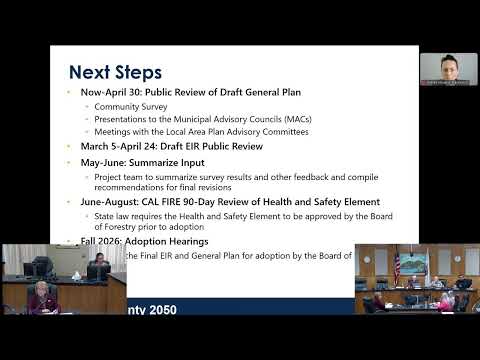
Staff outlined next steps: remaining local area plan advisory committee meetings through late April, a close of the general public comment period at the end of April, a planned Planning Commission hearing in August, and Board of Supervisors hearings in September for final consideration and potential adoption.
No formal votes or regulatory changes were adopted at the meeting; staff will revise language, reconcile GPAC comments with the hazard mitigation plan and other technical appendices, and return updates as the public comment period closes.