Get Full Government Meeting Transcripts, Videos, & Alerts Forever!
Get email alerts on the Elections topic
No spam. Unsubscribe anytime.
Rep. Griffith raises concerns about vote-by-mail, citing caregiver and language risks
Summary
Rep. Griffith told the House Administration committee he opposes vote-by-mail for himself and warned that mail ballots can be misused when caregivers or people with limited English fill them out; witnesses said signature checks and voter-ID reduce but do not eliminate such risks.
Rep. Griffith (Representative from Virginia) used his five-minute recognition before the House Administration panel to say he has reviewed the bills under discussion and supports them because "there is no attempt to invalidate any legitimate votes." He then focused on mail-in voting, saying, "I have never voted by mail. I will never vote by mail," and asking whether panelists were aware that caregivers or family members sometimes complete ballots for elderly or incapacitated relatives.
Griffith described a personal example: his mother, who "lived to be 92," became comatose three days before she died but had been competent while voting. He said that in many households a son, daughter or caretaker may receive a ballot and — even if well-meaning — cast it for an elderly family member who is no longer competent. "How are you going to verify that?" he asked, saying signature replication by relatives is common in his family.
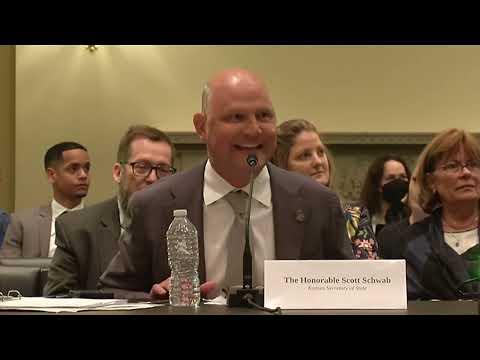
When Griffith asked for panel reactions, Mr. Simon replied, "Anything's possible." Mr. Schwab said Kansas uses signature verification and voter identification ahead of the mail ballot, and that those steps "really limit[] that from happening in our states," calling signature verification "key to preventing exactly what you're saying." Griffith countered that signatures can be copied (he said his wife can copy his signature and his sister could replicate their mother's), raising doubt about how reliably such checks stop improper votes.
Griffith also connected the issue to registration processes, saying that if motor-voter or driver-license signups are conducted in English, new arrivals with limited English may not understand what they signed and could inadvertently register or vote in ways that expose them to criminal liability. He framed this as a concern that laws without citizenship verification can "set people up to make felonious mistakes" without the required mens rea.
The transcript records the exchange and the panelists' brief responses; it does not record any formal motions, votes or committee action related to changes in law. No additional procedural outcomes were recorded in the provided segment.