Get Full Government Meeting Transcripts, Videos, & Alerts Forever!
Get email alerts on the Election Administration topic
No spam. Unsubscribe anytime.
House panel hears contrasting absentee ballot safeguards; Oklahoma official urges voter ID over signature checks
Summary
Representative Bice questioned two state election officials on absentee ballot verification, contrasting Oklahoma’s application, notary and ID-linked safeguards with Minnesota’s use of a driver's license/partial Social Security number, signature verification and a witness requirement. Officials defended layered checks.
Representative Bice, the representative from Oklahoma, used his allotted five minutes to press two state election officials on how their jurisdictions secure absentee ballots.
"We have no-excuse mail ballots, but you do have to apply still," said Mr. Schwab, describing Oklahoma’s process and emphasizing procedural safeguards intended to prevent counterfeit or improperly submitted ballots. Schwab said the state requires an application and checks including envelope-name matching and a driver's license number on the application, and that certain paper and barcode features prevent home-printed ballots from being counted.
Bice asked whether states require voter identification or rely on signature verification. "We do signature verification on the ballot, [and] voter ID on the application," Schwab said.
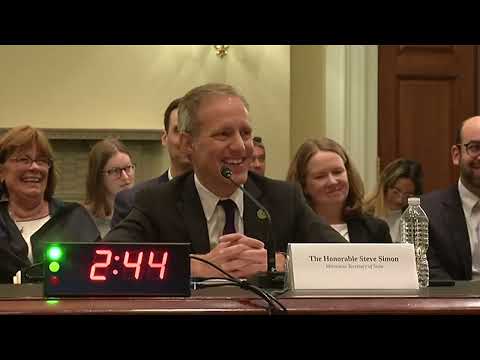
Mr. Simon described Minnesota’s approach: when a voter orders an absentee ballot they must provide a driver's license number and/or a partial Social Security number (he said election officials increasingly recommend providing both). "Then when they get the ballot after voting, they have to sign," Simon said, adding that Minnesota also requires a witness signature. "So there's really three layers of protection. It's the personal identifying information, it's the signature of the voter and it's the signature of a witness."
When asked how counties verify a witness signature, Simon said practices vary by county and depend on signatures on file; counties may pursue follow-up in some cases. He clarified that the witness’s signature itself is the primary verification and that additional identifying data such as a Social Security number or driver’s license is not required for the witness.
Bice recounted Oklahoma’s historical notary requirement, saying it originated after fraud in the 1960s and that the state’s notary requirement was challenged in 2020 because of COVID. He noted that during the public-health emergency Oklahoma accepted a photocopy of a valid driver’s license (which includes a signature) as an alternative form of identification. "I have concerns with signature verification," Bice said, adding that he favors voter identification as a more reliable safeguard.
No formal motions or votes were recorded in this exchange. The discussion closed with officials defending layered verification approaches and acknowledging trade-offs between accessibility and security; the hearing then continued to other questions beyond the provided transcript excerpt.