Get Full Government Meeting Transcripts, Videos, & Alerts Forever!
Get email alerts on the Artist Profile topic
No spam. Unsubscribe anytime.
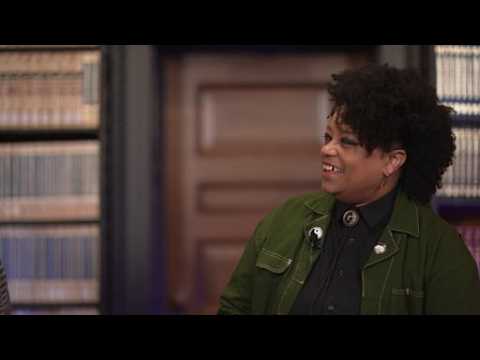
Amythyst Kiah reflects on Appalachian roots, Native Daughters collaboration and the origins of "Black Myself"
Summary
At a Library of Congress symposium, singer‑songwriter Amythyst Kiah traced her musical roots from a music‑filled childhood and ETSU’s bluegrass program to her work with Native Daughters, describing how archival recordings and collaboration shaped her song "Black Myself."
Nicole Saylor, director of the American Folklife Center at the Library of Congress, introduced singer‑songwriter Amythyst Kiah at a symposium tied to the COVID‑19 American History Project and said Kiah will perform at the Library of Congress tonight.
Kiah described growing up in a home where both parents valued recorded sound and said she began playing guitar at 13. "My dad is an audiophile," she said, recalling cassette decks, reel‑to‑reel tape and a range of playback equipment that exposed her to blues, rock, disco and jazz. She later learned fingerstyle techniques after taking a semester of classical guitar at an arts high school and, she said, was introduced to traditional and old‑time music while studying at East Tennessee State University.
The interview focused heavily on Kiah’s collaborative and archival work. She told Saylor that she discovered a Vera Hall a cappella recording on the Library of Congress website and "immediately recognized" the performance, which led her to reimagine the song with guitar and to incorporate archival material into her recordings. That archival interest fed into her work with the supergroup Native Daughters: "Rhiannon reached out to me," Kiah said, and within weeks the group traveled to Louisiana to write and record for a Sony and Folkways project that became a rapid, co‑writing experience.
Kiah discussed the creation and themes of "Black Myself," which she wrote after those sessions. She said the song's verses deliberate three historical perspectives — enslaved people, Jim Crow‑era gatekeeping and present‑day acknowledgment of earlier activists — and that certain lines reference colorism and historical erasures, noting the influence of recordings such as Syd Hemphill's John Henry. "I don't pass the test of the paper bag because I'm black myself," she said, explaining the lyric as a reference to colorism and exclusionary social practices.
She also described the process of turning disparate recordings into a cohesive album after signing with a label: some songs were re‑recorded at Sound City with producer Tony Berg to make a unified release. Kiah said touring the record required revisiting difficult personal material, which became emotionally taxing when paired with the public attention the songs received.
The session closed with Saylor directing listeners to loc.gov to view Kiah's concert; Kiah said she would perform songs from Wary and Strange and selections tied to her COVID‑era record Still and Bright.
Kiah’s comments illuminate how formal study, archival research and collaborative projects have shaped both her songwriting and her approach to presenting Appalachian and American roots material to contemporary audiences.