Get Full Government Meeting Transcripts, Videos, & Alerts Forever!
Get email alerts on the Drug Supply Surveillance topic
No spam. Unsubscribe anytime.
Providers and city warn of shifting drug supply; RAD testing, drug-checking and wastewater surveillance expand
Summary
Officials and recovery providers told the council that Baltimore's drug supply is evolving (more stimulants, polysubstance samples and veterinary tranquilizers such as medetomidine), prompting increased RAD testing, a CDC Epi-Aid request, a Johns Hopkins drug-checking grant, and plans to explore wastewater surveillance and ED trainings.
City health officials and providers told the Baltimore City Council's Public Health and Environment Committee that the drug supply is changing rapidly and that the city is scaling monitoring and response tools.
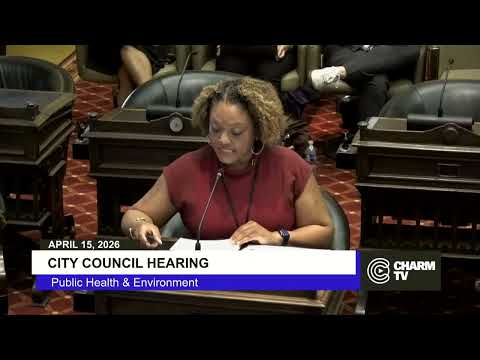
At public testimony, V McCormack, executive director of New Life Recovery Center, gave provider data: "Baltimore recorded 568 fatal overdoses in 2025. That's a nearly 27% decrease from 777 deaths recorded in 2024. Of the 568 total deaths, 425 involve fentinol." McCormack urged that smaller community providers be considered in funding decisions.
Health officials described changes detected by RAD (rapid analysis of drugs) testing and regional alerts. Dr. Michelle Taylor said the city is seeing fewer samples dominated by fentanyl and more stimulant presence, and that 36% of samples contained none of the substances the submitter expected, increasing unintentional overdose risk. Executive Director Sarah Whe said the city and state have amplified a state threat alert about medetomidine (a veterinary sedative often seen with xylazine) and jointly requested a CDC Epi-Aid to investigate emerging contaminants.
To expand real-time detection and public information, the administration awarded a $250,000 grant to Johns Hopkins' Check It program to expand FTIR mobile drug-checking services, which offer point-in-time testing to people and provide essential data to the city and state. Officials also described the city's RAD-sample pipeline (385 samples reported in the hearing) and said Baltimore submits more RAD samples to state programs than other Maryland jurisdictions.
Officials told the committee they are building regional information-sharing and are considering wastewater surveillance pilots as an early warning system. They also stressed training for emergency departments and hospitals to recognize atypical presentations when people ingest contaminants; the city plans clinician training and an Academic Detailing initiative to improve prescribing and MOUD (medication for opioid use disorder) uptake.
Council members questioned which actors should provide clinical training. Dr. Taylor said the city is focused on the local provider pool and will pair technical assistance with relationship-building and hospital convenings; some council members urged coordination so hospitals carry more responsibility for clinician training.
What remains unresolved: provider-reported overdose counts and toxicology details that appear on medical-examiner reports require follow-up with the state medical examiner and HIPAA- and certificate-based limits on individual-level data. Council members requested a briefing after the CDC Epi-Aid and further detail on RAD and wastewater plans.
Representative quote: BC Moore said the CDC Epi-Aid will "help us better understand emerging contaminants in the drug supply and how they move into the city."