Get Full Government Meeting Transcripts, Videos, & Alerts Forever!
Get email alerts on the Governance topic
No spam. Unsubscribe anytime.
LA Unified board seeks inventory, clearer rules for board‑created task forces and committees
Summary
Board members directed staff to complete an inventory and assessment of board-created task forces, work groups and advisory bodies, and signaled they will revise board rules to clarify staff lead roles, composition, review timelines and transparency. The effort builds on an IAU report and will feed a March rules review.
The Los Angeles Unified School District’s Committee of the Whole on Nov. 4 directed staff to carry out a district-wide inventory and assessment of board-created committees, task forces and advisory groups and recommended changes to board rules that would clarify how those bodies are formed and overseen.
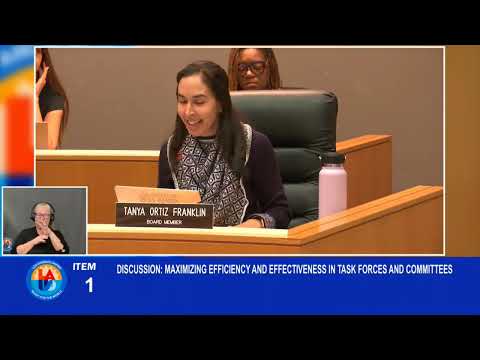
Board member Ortiz Franklin opened the discussion by asking the board to balance efficiency with participation and to use an Independent Analysis Unit (IAU) inventory to classify existing groups (standing, ad hoc, working group, mandated) before deciding whether to consolidate or sunset any body. "We should start with an assessment," Ortiz Franklin said, urging an approach that protects community voice while limiting duplicative work.
Members debated specifics. Several board members, including Kelly and Carla, pressed for clarity on what a "staff lead" would do — whether a staff member is a convener or a de facto decision-maker — and asked staff to define the role in writing. "Is the staff person a facilitator or the accountable lead?" Carla asked; Ortiz Franklin replied that the staff lead would convene and organize rather than hold all authority.
Board members also discussed timelines and institutionalization. Mr. McClean, appearing for the district’s legal/board support staff, said revisions to the board rules are on a review track that could begin formally in March and may be adopted later in the year, and he noted the board could act by resolution or through amended rules. Several members recommended the IAU complete its assessment before the board votes on consolidation or termination of any group.
The discussion flagged legal and practical constraints, including Brown Act implications for bodies that take action; counsel noted groups that direct public action must adhere to open‑meeting rules. Members asked staff to report back on composition practices (how chairs/co‑chairs are selected), whether chairs are community members, how committees present to the board, and how to preserve institutional memory (a central repository for committee charters and decisions was urged).
Next steps identified by the committee: finish the IAU inventory and assessment; define staff lead responsibilities and committee types; consider adopting a standard resolution template for creating groups; and fold the results into a March review of board rules that would include timelines and annual reporting mechanisms. Board members said they want any recommendations brought to the full board for vote after staff completes the inventory and proposed policy language.
The committee agreed the work should be transparent and inclusive, and members emphasized a process—rather than immediate closures—that starts with data and community engagement before formal action.