Get Full Government Meeting Transcripts, Videos, & Alerts Forever!
Get email alerts on the Public Health Fees topic
No spam. Unsubscribe anytime.
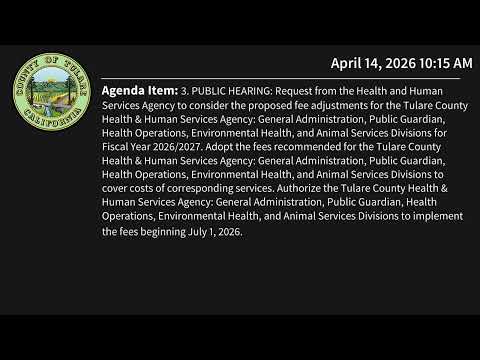
Tulare County adopts Health & Human Services fee changes affecting records, clinics and environmental permits
Summary
The Tulare County Board of Supervisors adopted a range of fee adjustments for the Health & Human Services Agency that update record‑request charges, clinic billing methodology, and multiple environmental and animal‑service fees; most changes take effect July 1, 2026.
The Tulare County Board of Supervisors on April 14 adopted a package of fee schedule changes for the county Health & Human Services Agency (HHSA) that officials said are intended to align charges with statutory limits and recover a greater share of service costs.
Rob Stewart, HHSA director of fiscal operations, told the board the proposal covers general administration (records requests and subpoenas), public guardian charges, health care center clinic rates, public health laboratory services, environmental health permits, and animal services procedures. Stewart said the county published public notices and reviewed the proposal with county auditors and counsel before the hearing.
Stewart highlighted several specific items: establishing a paper copy fee for medical and behavioral health records consistent with the California Health and Safety Code (up to $0.25 per page); an electronic record fee of $6.50 under state law; a clerical fee capped at $16 per hour for staff time processing records; and attorney subpoena and witness fees (the staff recited a $275 state witness fee and a federal formula of $40 per hour plus travel). He also said the public guardian fee tied to Social Security Administration guidance will rise from $55 to $57.
On clinic billing, Stewart said the county uses a methodology of 200% of the Medicare fee schedule (and 200% of Medicaid where Medicare rates are absent) so that charges are consistent with locally prevailing rates and federal requirements for Federally Qualified Health Centers. The staff presentation also listed a mix of additions, increases and decreases across clinic CPT codes; full fee details are in the agenda attachment titled “Summary of Proposed Fees.”
Environmental health proposals drew attention from board members and staff. Stewart described two new dairy‑program fees: an antibiotic residue investigation surcharge for multiple residues, and an optional “rapid reinstatement” service that can shorten a typical 48‑hour downtime to approximately four hours so dairies can resume sales more quickly. A supervisor noted the potential for large financial losses when dairies are taken offline and said the optional faster retest was requested by industry participants.
The environmental health package also includes larger adjustments to well permit fees and mobile food‑vendor/commissary permits; Stewart said staff capped many environmental fee increases at approximately 18% to phase in cost recovery while limiting shock to businesses. Animal services proposed 12 increases for spay/neuter and related veterinary procedures for shelters and rescue organizations to bring local rates closer to peer facilities.
No members of the public spoke during the hearing. After board questions were addressed, Supervisor Larry McCari moved to adopt the HHSA fee schedule as presented; Supervisor Pete Vanderpool seconded. The board approved the package on a recorded vote, 4–0, with Supervisor Dennis Townsen absent. County staff said the changes will take effect July 1, 2026.
What happens next: the adopted schedule and full rate tables are filed as part of the board record (Attachment A to the agenda item). The county will notify affected providers and post the updated fees; the staff presentation noted some charges are governed by specific state statutes and federal program rules that limit or prescribe maximum recoverable rates.
Speakers quoted in this article are drawn from the meeting record: Rob Stewart, Director of Fiscal Operations, HHSA; Supervisor Larry McCari; and Supervisor Pete Vanderpool.