Get Full Government Meeting Transcripts, Videos, & Alerts Forever!
Get email alerts on the Workforce Economic Development topic
No spam. Unsubscribe anytime.
House committee advances broad workforce, economic-development bill after rejecting $100 million ‘metro surge’ aid amendment
Summary
The House Workforce, Labor and Economic Development Finance and Policy Committee advanced House File 37 32 (DE2), a multipronged workforce and economic-development bill that creates an Office of Community Investment, codifies several programs and adjusts grant rules. Members debated but voted down a Representative Frazier amendment to provide $100 million in relief to businesses affected by federal "metro surge" enforcement.
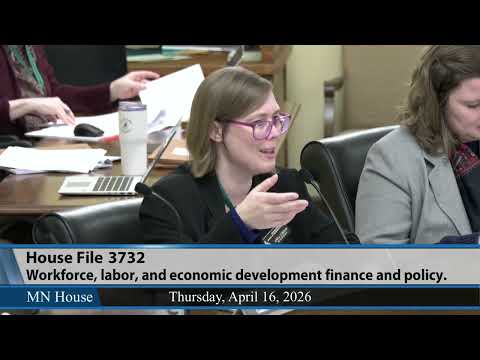
St. Paul — The House Workforce, Labor and Economic Development Finance and Policy Committee on April 16 advanced House File 37 32 (DE2), a package of workforce, grant‑making and regulatory changes, and recommended the bill for referral to the Ways and Means Committee.
The measure, presented jointly by committee chairs, combines technical changes, new grant programs and a proposal to create an Office of Community Investment inside the Department of Employment and Economic Development (DEED). Committee members adopted a friendly amendment to require that the new office engage the Legislature, the executive branch and the broader community when setting priorities.
House research and fiscal staff summarized the package and fiscal impacts. Staff said the DE2 amendment integrates support services — such as childcare and bus passes — into existing training grant programs so applicants would not need to apply to multiple funds; it would add support services as allowable costs for youth programs; and it would codify the Pathways to Prosperity program. The bill also creates a Health Care Workforce Grant program and proposes a subcommittee of the Governor’s Workforce Development Board to recommend up to $10 million in awards to the Legislature every two years.
"Sections 2 through 5 integrate support services as a component of existing grant programs rather than requiring groups to do a second grant program," a House research staffer said during the walkthrough. House fiscal staff reported a net General Fund impact of about $358,000 in fiscal year 2027 and roughly $800,000 for the 2028–29 biennium; Workforce Development Fund impacts were reported at about $401,000 in FY2027 and $822,000 for the 2028–29 biennium. The Office of Community Investment was described as roughly a $410,000 per‑year General Fund item; repeal of obsolete programs would save roughly $42,000, staff said.
The bill contains a series of technical and cleanup provisions: Article 2 incorporates Department of Labor and Industry technical language (including changes to electrician licensing and fees); Article 3 revises Explore Minnesota Council membership; Article 4 aligns statute with how the Northern Technology Initiative Inc. has actually operated for two decades; and Article 5 repeals a set of obsolete programs and returns small stranded balances to the General Fund.
"This is just getting things into compliance," a chairs’ staffer said about the Northern Technology Initiative changes, noting the entity has operated under a different name and governance in recent years.
A public witness, Josiah More, who identified himself as legislative director of the Department of Labor and Industry, spoke in support of Article 2’s construction‑codes and licensing provisions and thanked staff for the technical updates.
Major amendment debate
Representative Frazier moved an amendment to allocate $100 million to Minnesota businesses he said were harmed by federal enforcement activity described in the hearing as the "metro surge." Under the amendment as described by the sponsor, $50 million would come from the General Fund and $50 million from another state fund (as described in the amendment text), and the funds would be distributed through philanthropic foundations and initiative foundations to reach affected businesses statewide.
"We understand the impact of metro surge on businesses, workers and your communities. We are bringing legislation to address that our government caused this issue," Representative Frazier said in urging support.
Representative Schultz opposed the amendment on process and timeliness grounds, saying she doubted a newly created distribution mechanism would get funds to businesses quickly. "I'm concerned with this particular program from a perspective of trying to get the money out as quickly as possible," Schultz said. She asked why the amendment retained specific language referencing federal enforcement dates rather than using neutral date ranges.
Proponents described visible business closures and ongoing economic harm in parts of Minneapolis and Saint Paul and urged immediate relief. Opponents and some chairs urged caution about creating a new program rather than using existing mechanisms or pursuing longer‑term policy changes to improve business resilience.
The committee took a roll call on the amendment. The clerk recorded seven ayes and seven nays; the amendment therefore failed on a tie vote.
Next steps and implementation questions
After the amendment failed, members returned to discussion of the Office of Community Investment and asked DEED officials whether the new office could be formed by consolidating existing agency units to limit new costs. Mr. Badri, the agency’s government‑relations director, said DEED is analyzing the proposal and would return with further implementation detail, including the number and structure of offices affected.
Committee chairs then renewed the motion that HF 37 32 (DE2), as amended, be adopted; members approved the motion by voice, and the bill was recommended for referral to the Ways and Means Committee.
Committee members closed with thanks to committee staff, researchers and pages who supported the work over the session. The meeting was adjourned.
What the bill would do (key elements)
• Integrate support services (childcare, transit passes) into existing workforce training grants so providers need not apply to multiple programs.
• Create a codified Health Care Workforce Grant program and require annual reporting on program metrics.
• Establish an Office of Community Investment at DEED to coordinate grant‑making across state government and provide an appropriation for staff.
• Create a subcommittee of the Governor’s Workforce Development Board to recommend up to $10 million in workforce awards to the Legislature on odd‑numbered years.
• Make technical changes at the Department of Labor and Industry and adjust Explore Minnesota Council membership.
• Repeal several obsolete programs and return small stranded funds to the General Fund.
Votes at a glance
• Amendment (Representative Frazier) to appropriate $100 million for businesses affected by the "metro surge": Roll call — 7 ayes, 7 nays; amendment failed.
• HF 37 32 (DE2) as amended: Adopted by the committee and recommended for referral to the Ways and Means Committee (voice vote).
Who said what (selected quotes)
"We understand the impact of metro surge on businesses, workers and your communities. We are bringing legislation to address that our government caused this issue," Representative Frazier said in arguing for the $100 million amendment.
"I'm concerned with this particular program from a perspective of trying to get the money out as quickly as possible," Representative Schultz said, explaining her vote against the amendment.
"Sections 2 through 5 integrate support services as a component of existing grant programs rather than requiring groups to do a second grant program," a House research staffer said while walking members through the DE2 amendment.
Background and context
The bill bundles a range of workforce and economic‑development provisions that supporters say improve transparency, reporting and the efficiency of grant programs. Members split on whether an urgent, targeted relief program for small businesses harmed by recent enforcement activity should be created now or whether existing programs and longer‑term policy reforms are preferable.
The committee’s action sends HF 37 32 to the House Ways and Means Committee, where fiscal and budgetary details will be reviewed before further floor action.