Get Full Government Meeting Transcripts, Videos, & Alerts Forever!
Get email alerts on the Sanctuary Policy topic
No spam. Unsubscribe anytime.
County briefing lays out policy options to reaffirm sanctuary protections; staff: MCSO/DCJ do not accept ICE administrative detainers
Summary
County staff presented two reports at the March 3 board briefing detailing client‑facing actions and eight employee/policy options to reaffirm sanctuary status, including proposals on data protections, signage, training, a prohibition on leasing county facilities for immigration detention, and clarifications that Multnomah County Sheriff’s Office and DCJ decline ICE administrative detainers.
Multnomah County commissioners received two reports on March 3 intended to shape a March 12 work session and a potential ordinance to reaffirm and strengthen the county’s sanctuary status.
Tracy Massey, the interim deputy COO and DCA director, said the reports respond to the board’s December resolution and were prepared to outline "specific actions that we can take" in client‑facing services and to summarize policy options for employee accommodations and protections. The reports reflect recurring community requests for unified, transparent messaging about what the county can and cannot do regarding federal immigration enforcement.
What the reports recommend: staff framed eight policy areas for consideration, including (1) prohibiting use of county funds to assist federal immigration enforcement, (2) prohibiting coordination that would suppress peaceful protest, (3) preventing county contracts or leases that would operate immigration detention centers, (4) clarifying notification and interactions when federal immigration law enforcement is present, (5) identifying restricted public‑building areas and using signage, (6) clarifying how immigration‑status data are stored and disclosed, (7) expanded and routine training for staff, and (8) employee supports (leave banks, Workday access to records, and negotiated provisions where required).
County officials emphasized legal limits and existing law. Sim Ogale, the county CIO, told the board, "The Multnomah County Sheriff's Office and Department of Community Justice do not accept ICE administrative detainers or holds and decline all related requests for information unless disclosure is specifically authorized under state law." Staff cited the Oregon Sanctuary Promise Act as the legal framework for declining administrative subpoenas and explained that a federal court could still issue an order compelling production.
Operational details and community concerns: staff described current adaptations — home delivery of food boxes by Bienestar de la Familia, expanded telehealth options in county clinics, weekly situational reports via the Emergency Operations Center, and coordination with communications teams — and noted financial and capacity strains from sustaining hybrid/virtual options while preserving in‑person services.
Commissioner questions and follow‑up: board members asked detailed operational questions — how signage would be deployed, how detainees are notified of rights and in what languages, device access in corrections, whether county facilities could be leased for detention centers, the impact of US Marshal holds versus ICE detainers, and what aftercare supports exist for families whose members are detained. Staff committed to written follow up and to integrating feedback from employee resource groups and community partners; they also plan to present draft ordinance options at the March 12 work session.
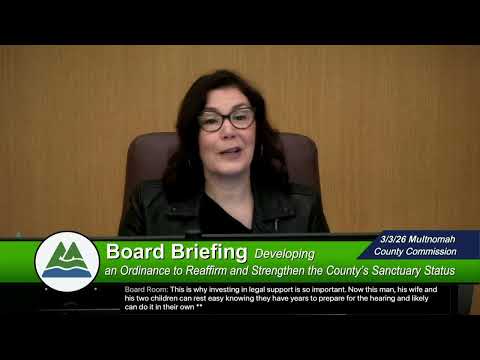
Community impacts highlighted: the chair summarized advocacy examples and cited local impact statistics from the Portland Immigrant Rights Coalition, saying nearly 100 people had been detained in the community so far this year, and described a case where county sanctuary funding helped secure legal support that postponed a client's immigration hearing.
No ordinance was adopted at the briefing; the board scheduled a work session on March 12 to continue drafting and to consider whether specific provisions should appear in an ordinance or in a resolution.