Get Full Government Meeting Transcripts, Videos, & Alerts Forever!
Get email alerts on the Municipal Budgeting topic
No spam. Unsubscribe anytime.
Charlottesville council agrees to one-cent tax plan and to expect 50% of any state school windfall
Summary
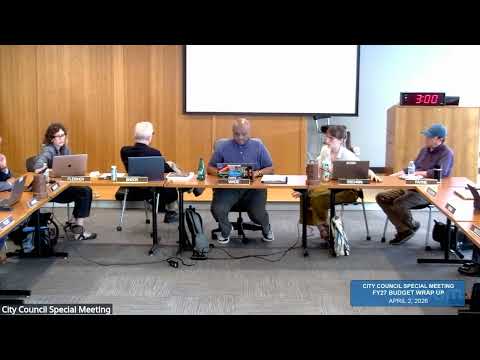
At a April 2 work session, Charlottesville City Council signaled support for a one-cent real-estate tax option conditioned on covering a $228,000 shortfall from the citywide reserve and agreed to pursue language to recapture roughly 50% of any additional state funds that Charlottesville City Schools receive this year.
Charlottesville City Council on April 2 agreed in principle to move forward with a one-cent real-estate tax option in its budget package and to cover an identified $228,000 shortfall from the citywide reserve, council members said at a wrap-up work session before next week’s budget vote.
The session focused on balancing the proposed $279 million budget and reconciling a gap created when staff updated revenue projections. Staff told the council a two-cent rate increase would raise about $2.4 million; a one-cent increase would raise about $1.2 million but leave roughly $228,000 to be made up through reserves or other adjustments. After discussion, council members indicated preference to use citywide reserves to close the gap rather than activate staffing scenario C for the transit (CAT) program or draw substantially from the council strategic initiatives fund.
Why it matters: staff said Charlottesville City Schools might receive between $500,000 and $900,000 in additional state funding depending on final action at the General Assembly. Under existing practice, if the city appropriates funds to the school board and the schools end the year with a surplus, a gain-share agreement historically splits the surplus 50/50. Council members debated whether to treat expected state aid as part of that mechanism and whether to adopt an explicit appropriation approach to allow the city to recapture part of any windfall.
Council members coalesced around a policy approach to ‘‘gain-share’’ any unexpected state funding this year at roughly a 50% split, using mechanisms such as placing an amount in contingency or including appropriation language to preserve the city’s ability to reclaim half of any excess revenues above the budget baseline. Staff said it would draft the precise mechanism — for example, a contingency holdback or periodic (quarterly) allocations — for inclusion in the budget ordinance and accompanying materials before final adoption.
Councilors noted legal and practical constraints. Staff advised that once funds are fully appropriated to the school board there are limited means to retrieve them without school-board consent, and the city would prefer contingency or phased appropriation language rather than an untested clawback provision. Members expressed interest in protecting city budget flexibility while avoiding a sudden shock to school operations.
Next steps: staff will prepare budget language reflecting the council’s direction on the one-cent revenue adjustment and draft options for the 50% gain-share mechanism in time for the Monday first reading and the Thursday adoption vote. The council’s schedule calls for a public hearing on the real-estate tax rate Monday, with adoption expected on Thursday.