Get Full Government Meeting Transcripts, Videos, & Alerts Forever!
Get email alerts on the State Trails topic
No spam. Unsubscribe anytime.
Senate committee hears data showing state trails falling into disrepair and seeks regular bonding for rehab
Summary
Sponsors and trail advocates told the committee that Minnesota’s state trail network needs sustained investment, citing photographic and sensor-based data showing deterioration and safety risks; the bill would restart regular bonding to rehabilitate trails.
Sen. Susan Xiong urged the Senate Capital Investment Committee to fund repairs to the Minnesota state trail system on April 16, warning that deferred maintenance has left many trail miles in rough condition and creating safety risks for high-use corridors.
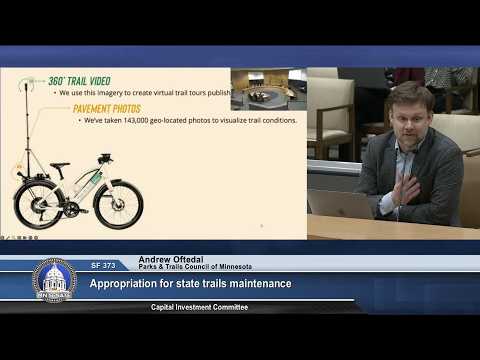
Andrew Oftedal of the Park and Trails Council of Minnesota presented research using repeated photographic surveys and vibration sensors that rate ride smoothness. Oftedal said the organization graded the system a B- in current aggregate condition but showed troubling trends: miles in rough condition have doubled in recent years and, if current funding levels persist, only about 41% of the system is projected to be in smooth condition by 2030.
Volunteer groups and local officials reinforced the testimony. Jim Mellor, vice president of the Gateway Browns Creek Trail Association, said the 6.9-mile stretch between St. Paul and Oakdale is currently in poor condition and that the trail’s heavy mix of commuter and recreational users heightens safety concerns. "The poor condition of this part of the trail has led to decreased use," Mellor said, adding that rough surfaces increase the risk of bike accidents.
DNR Parks and Trails staff told committee members they use asset-management processes to prioritize high-need sections but that funding availability constrains how quickly projects can proceed. Members asked about timelines and alternative funding sources; witnesses said past committee funding produced measurable rehabilitation on named trails (Casey Jones, Minnesota Valley) and argued for a restart of regular bonding for trail rehab.
The committee heard the presentations and public testimony and did not record a committee vote on the bill at this hearing; the measure was laid over for inclusion.