Get Full Government Meeting Transcripts, Videos, & Alerts Forever!
Get email alerts on the Immigration Enforcement And Accountability topic
No spam. Unsubscribe anytime.
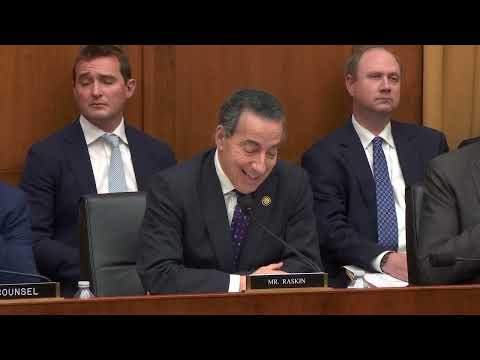
Ranking member from Maryland urges accountability for violent crime, criticizes ICE enforcement and pardons
Summary
The ranking member from Maryland opened a House Judiciary Committee hearing by thanking families of violent-crime victims and urging stronger accountability for perpetrators, criticizing broad ICE enforcement practices and presidential pardons he said have enabled further harm. He called for hearings and policy changes.
The ranking member from Maryland opened a House Judiciary Committee hearing by thanking the family members who traveled to Washington to tell the stories of loved ones killed or harmed and urged the committee to pursue accountability for perpetrators and federal agencies.
"Nothing hurts more than losing a child," the ranking member said, telling witnesses their testimony is "an important and powerful reminder" that the federal law-enforcement and justice system must protect victims and hold perpetrators accountable.
He framed the hearing as bipartisan and emphasized that members on both sides of the aisle are parents, grandparents and relatives who want to keep families safe. He said perpetrators should be "prosecuted to the fullest extent of our laws" and warned against blanket pardons given without "proof of remorse or rehabilitation or restitution to their victims."
On immigration enforcement, the ranking member criticized recent Department of Homeland Security and Immigration and Customs Enforcement practices as an overreliance on mass arrests, mass detention and mass deportation rather than focusing on the "worst of the worst." He alleged, during his remarks, that ICE has in some cases arrested noncriminals and U.S. citizens, and described instances—as recounted in the hearing—where children were used to locate and arrest parents.
He argued those enforcement patterns can undermine prosecutions, saying deportations before trial or in the middle of sentences can deprive victims of justice and "effectively, effectively" allow criminal defendants to avoid accountability in the United States.
The ranking member also said the committee must examine how survivors of high-profile sex-trafficking and abuse networks have been treated by institutions, naming Jeffrey Epstein and Ghislaine Maxwell in that context and urging hearings for survivors. He noted the First Lady's public support for hearings with survivors and said the committee should heed that call.
Addressing the aftermath of the Jan. 6, 2021, attack, he asserted that some pardon recipients have gone on to commit new offenses; the remark in the transcript named an individual and described subsequent alleged abuses. Those assertions were presented by the ranking member as part of his argument for stricter scrutiny of pardons.
He further cited an instance he described in the hearing in which an ICE agent shot a U.S. citizen, and said such incidents erode immigrant communities' trust in police and prosecutors, which in turn can make it harder to investigate and prosecute crimes.
He closed by thanking the witnesses again, saying their stories matter and urging the committee to pursue meaningful policy changes to keep people safe, ensure accountability and protect victims' rights. The hearing then continued to witness testimony and questioning from committee members.