Get Full Government Meeting Transcripts, Videos, & Alerts Forever!
Get email alerts on the Judiciary Budget topic
No spam. Unsubscribe anytime.
Committee deadlocks on judiciary budget after clashes over courthouse security and paid leave
Summary
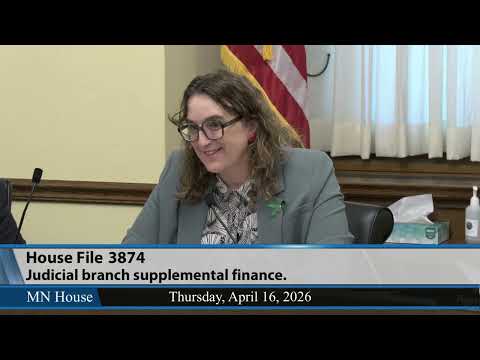
The House Judiciary Finance and Civil Law Committee debated House File 3874 — the judiciary budget bill — including amendments trimming security requests, increasing a courthouse grant program, and a failed attempt to remove an operating adjustment for paid family medical leave. The bill failed to advance after a 7-7 roll-call vote.
The Minnesota House Judiciary Finance and Civil Law Committee considered House File 3874, the judiciary’s budget bill, during its April 16, 2026 hearing and failed to advance the measure after a 7–7 roll-call vote.
Chair Liebling, the bill’s author, summarized the judiciary’s request as including funding for courthouse safety measures, a $1 million grant pool for courthouse security, home-security allowances for judges and administrators, and funding to cover the employer portion of paid family medical leave for judicial employees. She moved Amendment 7 to pare back some administrator-security allocations while preserving a flexible security pool and targeted positions for the Supreme Court.
“We take the security needs of the judiciary very seriously,” Chair Liebling said when explaining Amendment 7, which was adopted by the committee. She argued the committee should fund the courts’ reasonable requests while recognizing the judiciary’s institutional independence.
Representative Bliss moved an amendment to delete the additional operating adjustment that would cover the employer share of the Paid Family Medical Leave Act for court employees, characterizing the change as an unfunded mandate on taxpayers and businesses. “It’s similar to putting off buying a fancy pair [of] shoes until the next payday,” Bliss said, urging that state government be held to the same payroll standards as private employers.
Opponents said the courts, unlike private employers, cannot raise revenue and that the employer portion is an ongoing liability the branch has to meet. A member cited an estimate discussed in committee of roughly $1.9 million per year for that employer cost. After debate and a requested roll call, the attempt to delete the operating adjustment failed on a tied 7–7 vote.
Chair Scott successfully moved an amendment to increase the one‑time courthouse safety grant pool from $1 million to $4 million, saying past rounds left unmet grant requests. The State Court Administrator supported the increase and clarified those grants are intended for one‑time capital items — metal detectors and screening equipment — not for ongoing local staffing, which counties would have to fund.
A later amendment (the committee’s “5” amendment) that would have reduced several safety appropriations and focused funding on two judicial security‑unit positions (about $312,000) drew sustained opposition from members who cited rising threats to judges and concerns about doxxing. That amendment failed on a 7–7 roll call.
In the final action on HF 3874, the committee voted on a motion to refer the bill to Ways and Means. That roll call ended in a 7–7 tie and the motion did not prevail; the bill did not advance from committee.
State court administrators who testified offered technical clarifications about employee benefits, saying judicial employees participate in the state managed benefit package. Committee members repeatedly noted the distinctions between one‑time capital grants and ongoing personnel or employer‑mandate costs.
The committee’s votes left several provisions unchanged (including the adopted Amendment 7 and the increased courthouse grant pool) but the overall bill will not move from Judiciary Finance and Civil Law unless sponsors reintroduce it or take other procedural steps.