Get Full Government Meeting Transcripts, Videos, & Alerts Forever!
Get email alerts on the Zoning Fence Variance topic
No spam. Unsubscribe anytime.
Contentious Gilpin County fence‑height variance hearing draws allegations and remains open
Summary
A long Board of Adjustment hearing on a disputed after‑the‑fact fence extension in Gilpin County drew competing claims from the applicant and a neighboring property owner. Staff recommended denial; the applicant argued topographic and safety needs. The hearing was open for public comment at transcript end.
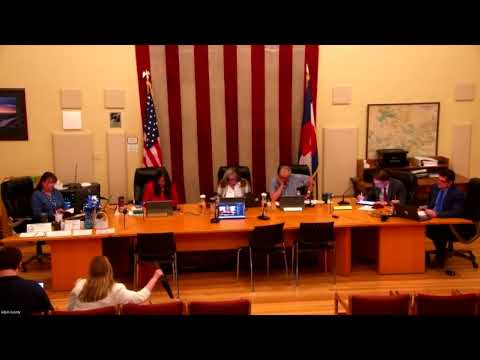
The Gilpin County Board of Adjustment heard extended testimony on BOA‑25‑6 on April 14, 2026, a variance request seeking after‑the‑fact approval for a vertical extension on an existing privacy fence, and left the hearing open after multiple public speakers.
Community Development Director Jamie Bole told commissioners the permit (BLG239) had been issued for an 8‑foot fence but subsequent inspections and a neighbor complaint found vertical wooden extensions that raised part of the fence to roughly 12 feet across about 52.6 feet. Staff measured the fence, examined topography and a raised earthen burm on the adjacent parcel, and concluded that the vertical extension largely could not be justified by on‑site physical conditions. Bole said staff "does not recommend approval of the request," noting the county's criteria require an exceptional, property‑specific physical condition to grant a variance.
The applicant, owner Chris (Kristen) McFarland, and her attorney Harmon Zookerman disputed that reading. Zookerman said the application is focused only on the portion of fence that actually exceeds code and asked staff to clarify how many feet of the extension are noncompliant. He argued the code’s allowance for "extraordinary and exceptional situation" should permit the board to consider the combination of topography and situational factors the applicant described.
McFarland told the board she installed the extension to block what she described as harassment and to shield her short‑term rental operation and tenants from an ATV course and other intrusions. "I put up a fence to block the behavior," she said, adding that the higher section makes a "massive difference in the quality of life" for her and her tenants.
Neighbor Michael Price — who filed the original complaint and is a party to prior litigation with the applicant — spoke during public comment, describing a history of disputes, alleging noncompliance and misconduct by the applicant and saying the application presented "nothing new" since the prior hearing. He urged denial and stressed his belief that the county should enforce its zoning rules impartially.
Staff recited the permit and enforcement chronology: the building permit had described an 8‑foot fence; a November 2024 complaint alleged up to 14 feet and subsequent measurements showed roughly 12 feet where extensions were added; code enforcement opened a case and the applicant appealed. The board previously considered a variance on March 25, 2025 and the vote failed to meet the unanimous concurrence required under state law (three concurring votes) to grant a variance. The application was refiled after the board allowed resubmission with new information.
A focal technical issue in staff testimony was how to measure fence height where a raised burm on the neighboring parcel sits within 10 feet of the fence. Staff explained that where the burm is within 10 feet, the highest adjacent grade must be used for measurement; where the burm is farther than 10 feet away, it does not factor into fence height. Staff said the vertical extension begins after the point the burm is more than 10 feet away, meaning much of the extension stands independent of the burm’s effect and would exceed the county’s 8‑foot maximum.
Staff also informed the board that written public comments from the complainant were received and placed into the record. Several commissioners asked procedural and measurement questions; staff noted that if any variance were granted, subsequent permit reviews (driveway access, septic, etc.) would still apply and be subject to separate approvals and inspections.
At the time the transcript ends, public comment was underway with both the applicant and the complainant presenting strongly divergent accounts; the board had not announced a final decision.
Next steps: the board must make written findings if it rules on a variance, and — under county practice and Colorado law — a concurring vote of three members is required to grant such relief.