Get Full Government Meeting Transcripts, Videos, & Alerts Forever!
Get email alerts on the Meeting Roundup topic
No spam. Unsubscribe anytime.
LAUSD board denies three charter renewals after hours of testimony and debate
Summary
At a Nov. 17 special meeting, the Los Angeles Unified School District Board of Education approved the consent calendar and denied renewal petitions for Inenium Charter Middle School, Matrix for Success Academy and Prepitech Los Angeles after presentations, extensive public comment and board deliberation.
The Los Angeles Unified School District Board of Education met Nov. 17 for a special session that included multiple charter renewal hearings, extended public comment and three denial votes. After approving the consent calendar, the board considered renewal petitions for Inenium Charter Middle School, Matrix for Success Academy and Prepitech Los Angeles and ultimately voted to deny each renewal.
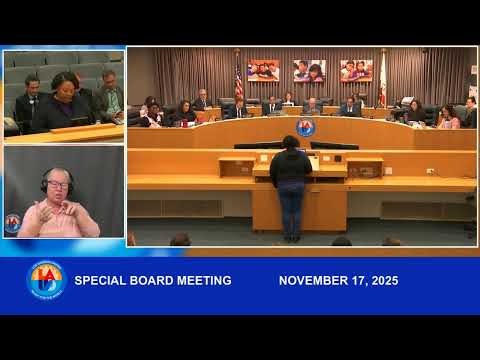
Board President Schmelson called the meeting to order at 9:07 a.m. and the board first approved tabs 1–22 on the consent calendar, then reopened discussion to allow a signed public commenter to speak before retaking and confirming the consent vote.
The board then moved to Tab 23, the renewal petition for Inenium Charter Middle School. Inenium leadership, represented by superintendent Bill Tumi, urged a five‑year renewal and disputed the Charter Schools Division’s (CSD) participation‑rate calculations and comparisons to selective programs. Dozens of students, teachers, parents and board members for the school told the board that Inenium serves a high‑need population (more than 90% Latino, high percentages of English learners and socioeconomically disadvantaged students) and offers wraparound supports. CSD staff described a three‑year, cascading analysis of dashboard and verified data, oversight visits and resident‑school comparisons as the basis for its recommendation. After debate over methodology, benchmarks and the interpretation of participation rates, the board approved the staff recommendation to deny the renewal (five yes, one no, one absent).
Tab 24, Matrix for Success Academy, drew testimony from hundreds of current and former students, staff, nonprofit partners and parents who described Matrix as a safety net for students who are credit‑deficient, experiencing homelessness, parenting or justice‑involved. Matrix leaders argued the school should be judged on alternative measures required of dashboard‑alternative (DOSS) charters (for example, long‑term enrolled student graduation, Lexile growth and credit completion). CSD staff said the district had engaged in multiple iterations with the operator to identify alternative metrics but ultimately lacked confidence that some proposed measures would produce consistent, whole‑school comparators for a renewal decision. After deliberation the board voted to deny Matrix’s renewal (four yes, two no, one abstention).
Tab 25 considered Prepitech Los Angeles. School leaders highlighted academic growth, district recognitions and steps taken in response to prior compliance notices. CSD staff summarized a county SULPA (special education local plan area) notice of non‑compliance and concerns about IEP and service documentation in Welligent and related systems. After public comment from feeder‑school teachers, parents and nonprofit partners who emphasized the school’s International Baccalaureate pathway and community partnerships, the board voted to deny the renewal.
The meeting concluded with public hearings on multiple new charter petitions (Tab 26), including presentations and community testimony, and adjourned at 1:31 p.m. Several board members said they valued the district’s oversight work but wrestled with how to measure schools that serve highly mobile or non‑traditional student populations. Any operator denied by the board retains appeal rights under state law.