Get Full Government Meeting Transcripts, Videos, & Alerts Forever!
Get email alerts on the Court Debt Programming Errors topic
No spam. Unsubscribe anytime.
State court administrators: programming error misallocated millions in court‑debt; corrections in place for FY25
Summary
State Court Administration officials told county stakeholders that programming errors in the JET case‑management system misallocated court‑debt distributions across FY2021–FY2024, estimating $27.5 million overallocated to the state general fund and corrections applied for fiscal year 2025; they will work with the legislature and auditors on options for prior years.
State Court Administrator Bob Gas told county stakeholders that an internal and external review found programming errors in the judicial branch’s case‑management system that misallocated court‑debt distributions across fiscal years 2021 through 2024, and that programming corrections implemented in late November have fixed distributions for the current fiscal year.
"The programming changes ... were implemented in late November ... our programming is correct moving forward for this fiscal year," Gas said, framing the webinar as an effort to explain what went wrong and how the administration plans to work with counties and the legislature on next steps.
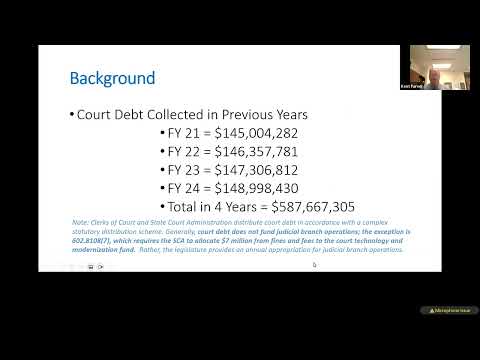
Why it matters: court‑debt payments flow through the JET case‑management system operated by clerk of court offices and are split among state funds and local recipients by statute and administrative rules. Kent Farber, Director of Finance for State Court Administration, said the branch processed roughly 500,000 criminal cases a year and that about $587 million in court debt was collected between FY21 and FY24. Based on the administration’s calculations, about $27.5 million was overallocated to the state general fund during those years, while other state funds were underallocated by about $23.6 million and local (non‑state) recipients were underallocated by about $3.9 million.
"During the time period ... there was just over $587 million in court debt that was collected," Farber said, noting the numbers summarize how distributions would shift if past years were corrected.
What the administration did: the court administrator said the office engaged an outside contractor (the National Center for State Courts) to do a technical programming review, and completed an internal legal analysis that produced a 65‑page report and a 45‑page memo describing the legal interpretation and required programming changes. The administration implemented a consolidated set of programming changes and applied corrected distributions to the start of fiscal year 2025 (July 1, 2024).
What it does not do: Gas and other presenters emphasized the administration does not have unilateral authority to reallocate money already distributed in prior fiscal years. "We do not have the authority to redistribute those years," Gas said; the administration said it will present the spreadsheet and findings to the legislature and stakeholders to discuss options for addressing the prior years’ allocations.
Next steps and verification: presenters said the administration has begun a multi‑step verification process that includes a second independent technical review, work with the auditor of state to verify the figures, and an internal audit of the IT and finance interfaces to confirm programming and staffing are adequate. Kent Farber demonstrated a searchable spreadsheet the administration will share with counties so each county can see the administration’s calculation of what would have changed for FY21–FY24. Farber cautioned that the spreadsheet was not immediately released because additional IT work and auditor verification remain.
What counties should expect: administrators said corrected distributions are in place for FY25 and that the spreadsheet will show per‑county adjustments across the four fiscal years. The administration also said there are practical complexities — for example, some local increases reflect money that would shift among county entities rather than new revenue from the state — and that county attorneys’ post‑threshold bonus payments (a 5% bonus after threshold) were not included in initial estimates due to calculation complexity.
The immediate outcome: corrected programming for FY25 is in place; for prior fiscal years the administration will provide detailed county spreadsheets, continue stakeholder outreach and meet with the legislature to discuss remediation options. The administration also said it is pursuing independent verification and clearer check‑stub reporting to help local governments identify the changes affecting their receipts.
Closing: the ISAC host said the association will distribute the final spreadsheet and recording to members and coordinate follow‑up sessions to walk counties through their results.