Get Full Government Meeting Transcripts, Videos, & Alerts Forever!
Get email alerts on the Traffic Signal Duff Hwy44 topic
No spam. Unsubscribe anytime.
City planner: interagency ownership, approvals slow Duff Lane–Highway 44 signal; $750,000 in pro rata funds set aside
Summary
The city planner told the Middleton Planning & Zoning Commission that the Duff Lane/Highway 44 intersection is owned by ITD and locally controlled by Highway District 4, and that the city has collected about $750,000 in a traffic pro rata trust earmarked for the intersection; a private developer may help fund a signal within one to two years.
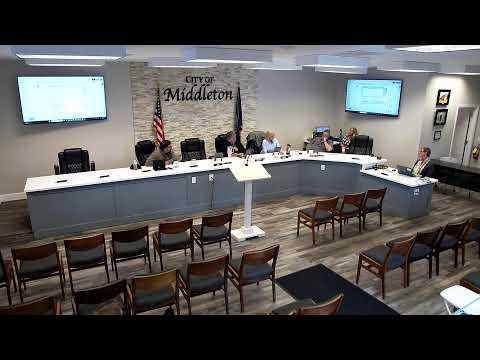
The city planner told the Middleton Planning & Zoning Commission on April 13 that the Duff Lane and Highway 44 intersection is not under city control, and that interagency approvals and outside funding are required to install a traffic signal.
“The intersection itself is actually owned by ITD, and the approaches . . . are actually controlled by HD4,” the planner said, noting an interagency agreement that places design and final authority with outside agencies. The planner said the city has collected about $750,000 in a traffic pro rata trust account specifically for improvements at that intersection.
The planner said the city uses a traffic pro rata mechanism (Middleton City Code 5-4-3) to collect money for intersection deficiencies not eligible under the transportation impact fee. She explained the typical calculation: a developer’s traffic study estimates a subdivision’s percent impact on a given intersection; that percentage is applied to an estimated construction cost to determine the developer’s pro rata contribution.
The planner said a developer associated with Republic Storage is assembling three adjacent subdivisions — described in the presentation as Gateway Northwest, Gateway Southeast and Gateway Northeast — and that the combined development could produce sufficient pro rata and negotiated contributions to fund construction. “We might see something there really starting to come together in a year to two years,” the planner said, adding that ITD and Highway District 4 are “fast tracking” design but that multiple approvals are still required.
The planner also explained Midstar funds, saying those regional impact dollars are discretionary and that each jurisdiction or district maintains its own Midstar pot; the mayor and city council determine local spending of Middleton’s Midstar balance and any city contribution would generally be contingent on matching or cooperation from Canyon Highway District 4 because the intersection is district-owned.
During public comment, resident Jim Gray urged the commission to press for interim relief. “If there’s any way we can get a right turn lane out . . . it would relieve a lot of the congestion at that intersection,” Gray said, describing long queues and driveway access problems for an adjacent parcel he said is for sale.
Commissioners and staff acknowledged the safety concerns but emphasized limits on the city’s authority. The planner and commissioners outlined technical and cost obstacles to interim fixes: required queue lengths could trigger major culvert work, a temporary slip lane could be damaged or removed once the full intersection is reconstructed, and the work would fall to HD4 or ITD for design and construction. Commissioners encouraged residents to keep the issue on the public record and to press HD4 and ITD for solutions.
The commission did not take any formal action on the signal at the April 13 meeting. The next procedural steps described were continued coordination between the city, the developer, Highway District 4 and ITD, and possible use of pro rata and Midstar funds if interagency partners commit to matching or complementary contributions.