Get Full Government Meeting Transcripts, Videos, & Alerts Forever!
Get email alerts on the Transportation Adaptation topic
No spam. Unsubscribe anytime.
Council and public urge funding for SacRT adaptation plan and Ride Free RT program
Summary
Council members praised the Sacramento Transportation Infrastructure Adaptation Plan but and several public commenters urged the council to secure funding to preserve the Ride Free RT student program and prioritize multimodal investments in heat‑vulnerable neighborhoods.
Council members and public commenters used the consent‑calendar debate and public‑comment period to press for concrete funding to implement the Sacramento Transportation Infrastructure Adaptation Plan and to save the Ride Free RT student transit program.
Council Member Kaplan, speaking about Item 7, called the Sacramento Transportation Infrastructure Adaptation Plan "great" but said the perennial question is how the city will fund and implement those plans. Kaplan highlighted North Natomas and Robla as areas lacking trees and multimodal infrastructure and said staff and partners must integrate tree canopy, pedestrian access and transit improvements to reduce urban heat‑island effects and make neighborhoods more walkable.
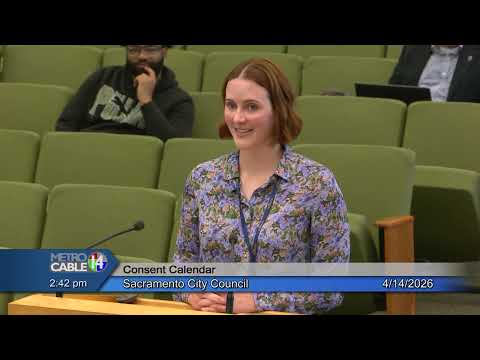
Denise Morgan, Third District PTA president, spoke in support of the related resolution and warned the Ride Free RT program is scheduled to expire in June if funding is not found. "Please make the Ride Free RT program a priority and don't let it end," Morgan said, emphasizing students’ reliance on the service for school and higher‑education access.
Julia Curry, a Midtown resident and PTSA leader, echoed those concerns during later public comment, describing how students use the program for school commutes and field trips and urging the council to preserve it despite tight budgets.
Council members acknowledged the program’s importance but framed the challenge as fiscal: Kaplan and others said identifying sustainable funding streams is essential and that implementation will require partnership with SacRT, developers, and regional stakeholders. No specific funding source was adopted during the meeting.